What Is a Plunge Bra? Fit, Shape & Who It Actually Suits

A plunge bra is a low-cut bra with a deep V-neckline and a low centre gore — the little bridge between the cups sits far down your sternum, so the bra stays hidden under plunging tops while pushing your bust gently together. It gives natural cleavage without the heavy padding of a push-up, and despite the myth, it works on far more than small busts. Below I'll break down what defines it, what it does for your shape, and whether it'll suit you.
What a plunge bra actually is
The one feature that makes a bra a plunge is that dropped centre. On a normal bra the gore sits high between the cups; on a plunge it plunges — hence the name — creating a low-cut, deep V-neckline silhouette. The angled cups are cut and wired to guide your breasts up and toward the middle, so you get shape and cleavage with less coverage across the top than a balcony or full cup.
What it isn't is a stripped-back, unsupportive bra. A good plunge still holds you properly — the support just comes from the band and the lower, angled cup structure rather than a tall centre. It's a genuine everyday option too, not a special-occasion-only piece, which is where a lot of people underrate it.
The design details that make it a plunge
Look inside a plunge and the wire tells the story. The underwire is often shaped like a J tilted on its side, with short wires at the front centre that let the narrow gore sit low. That cup cut angles inward, so the whole thing pushes your tissue up-and-in rather than straight up. It's a subtle bit of engineering that does a lot of the work.
Because the centre sits lower, the gore is usually narrow and dips well down the sternum — sometimes almost to the bottom of the band. You'll find plunges in moulded and seamless finishes for a smooth line under close-fitting tops, and in soft, unpadded versions that shape without adding volume. The common thread is always the same low, angled front.
What a plunge bra does for your shape
The headline job is cleavage — the low gore lets your breasts come together in the centre, creating a natural, rounded shape rather than the obviously boosted look a heavily padded push-up gives. You get lift and a bit of separation control at once: everything's drawn in and up, which enhances the silhouette without shouting about it.
The other quiet benefit is that it's invisible under the clothes it's meant for. Where a standard bra would peek out of a low neckline, the plunge pushes together underneath and stays out of sight, giving your outfit a clean boost. It's shaping you can actually wear to work as well as out.
Plunge vs balcony, t-shirt and push-up
Here's how it sits against its neighbours. A balcony bra has a straight-across top edge and wide-set straps — it lifts you up onto a shelf. A plunge does the opposite: it draws inward for a V. So if a balcony is about a lifted, propped shape, a plunge is about the centre.
A t-shirt bra is about invisibility under plain fitted tops, usually with a higher, smoother centre gore — great under a jumper, wrong under a wrap dress. And a push-up is really about padding: it adds volume, whereas a plunge shapes what's already there. Compared with a full cup, the plunge simply trades coverage for a lower neckline. The honest one-liner: choose a plunge when the neckline is the problem, not the top itself.
Does a plunge bra work for a bigger bust? (myth, busted)
This is the misconception I hear most: that anything above a G cup rules a plunge out. It doesn't. It's a myth. Fuller-bust brands cut plunges right up to a K cup — Freya's range runs B to K — and plenty of fuller bust wearers swear by them; you'll find H cup fans who reach for a plunge specifically for a night out.
The trick is construction. A well-made plunge for a larger cup uses proper support — a firmer band, often three hooks and a wider band at the back to carry the weight, with the low gore still giving uplift and shape. So don't write it off by size. Write it off only if you try one and the fit genuinely doesn't work for your shape, which is a different thing entirely.
Close-set vs wide-set — will it suit you?
Breast placement matters more than size here. If your breasts are close-set — not much gap at the sternum — a plunge is often ideal, because the narrow gore slips neatly into that space and the low front means you avoid a tall bridge digging in. If you've ever found a standard high gore uncomfortable on a sensitive breastbone, a plunge can be a revelation for comfort.
If you're wide-set or your breasts sit projected and far apart, the gore may not sit flush and the cups can feel like they're reaching to pull you together. In that case a balconette usually suits your breast shape better. As always, the fit test decides — but placement is the single best predictor of whether a plunge will love you back.
Types of plunge — padded, moulded, deep and super plunge
"Plunge" covers a small family. A moulded or lightly padded plunge gives a smooth, opaque finish and is your everyday workhorse under tees and jumpers. A non-padded or soft plunge shapes without bulk, letting a more low-cut neckline breathe. You'll also see mesh and lace versions for prettier, going-out pieces.
Then there's depth. A standard plunge dips moderately; a deep plunge or super plunge drops the centre dramatically for the most revealing necklines, while a higher plunge keeps a touch more centre coverage for tops that aren't quite so extreme. Matching the depth to your neckline is the difference between a bra that vanishes and one that peeks.
The necklines and outfits it's built for
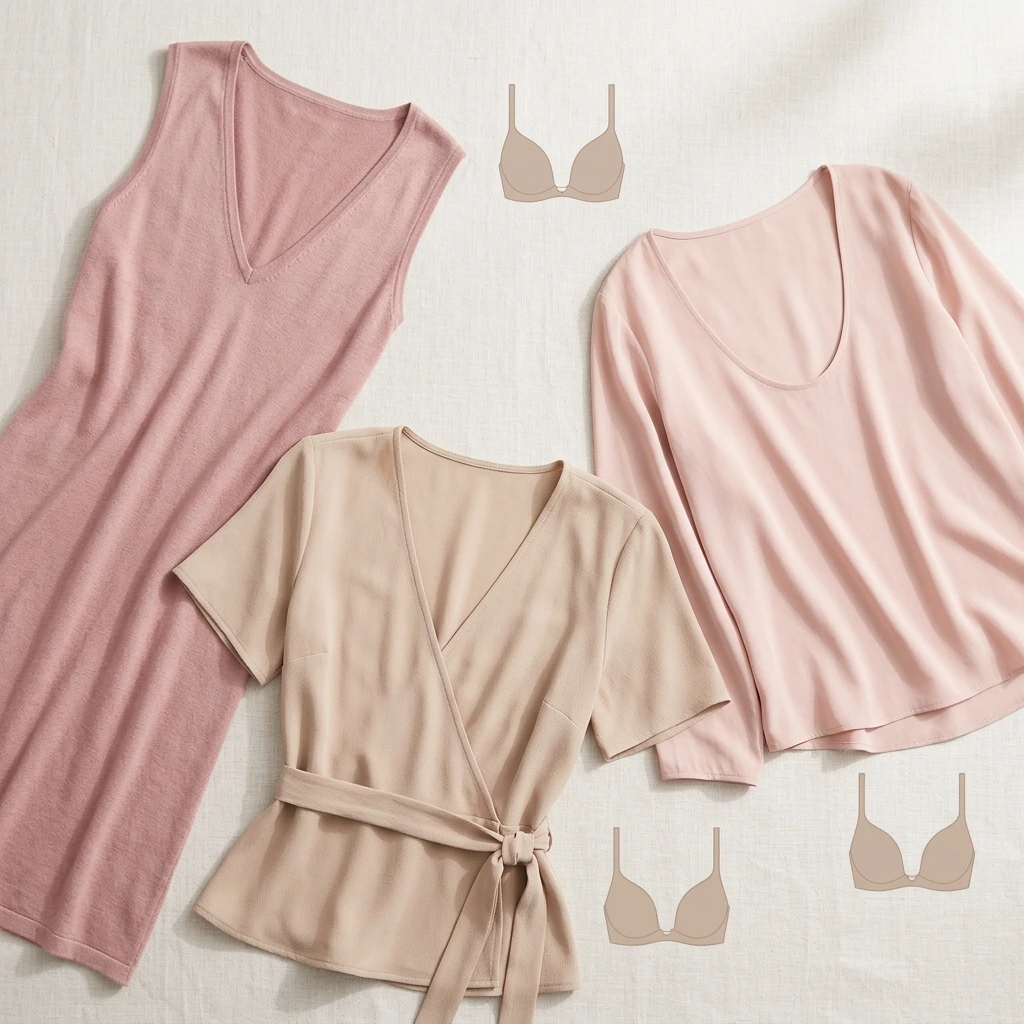
Reach for a plunge whenever the neckline dives. It's made for low-cut tops, V-neck dresses, wrap tops and any deep neckline or plunging cut that a normal bra would spoil. Because the wires are shorter, it also behaves under tops that are low at the sides, where a taller wire would poke out.
The bonus is versatility — the right moulded plunge takes you from day to night, staying hidden under work clothes and out-out dresses alike. About the only necklines where it's the wrong call are very high or very wide styles, where the straps or shaping aren't playing to their strengths and a balcony or full cup fits the outfit better.
How to get the fit right
Same underwire fundamentals apply, starting with the band: it should sit level around your ribcage, snug on the loosest hook, doing most of the support so a lower gore doesn't leave you unsupported. First, confirm your measured bra size using our full guide. The gore should lie flat against your sternum — if it floats off, the cup's too small or too wide-set for a plunge; if it digs, you may want a lower or narrower one.
Check the cups fully hold you with no spillage over the low edge and no gaping at the top, and that the straps support without carving into your shoulders. When you raise your arms the band shouldn't be riding up. If the size is close but not perfect, a sister size (band up/cup down, or the reverse) can save the fit before you abandon the style — and because plunges vary a lot between brands, treat your measured size as the starting point and let the mirror settle it.
Frequently Asked Questions
It's designed to stay hidden under low-cut and deep-V necklines while pushing your breasts together for natural cleavage and a lifted, rounded shape.
Need to check your measurements right now?
Use our free online UK Bra Size Calculator to calculate accurate band and cup sizes in seconds using cm or inches.
Calculate Bra Size Free