How to Work Out Your Bra Size — The Complete Measuring Guide
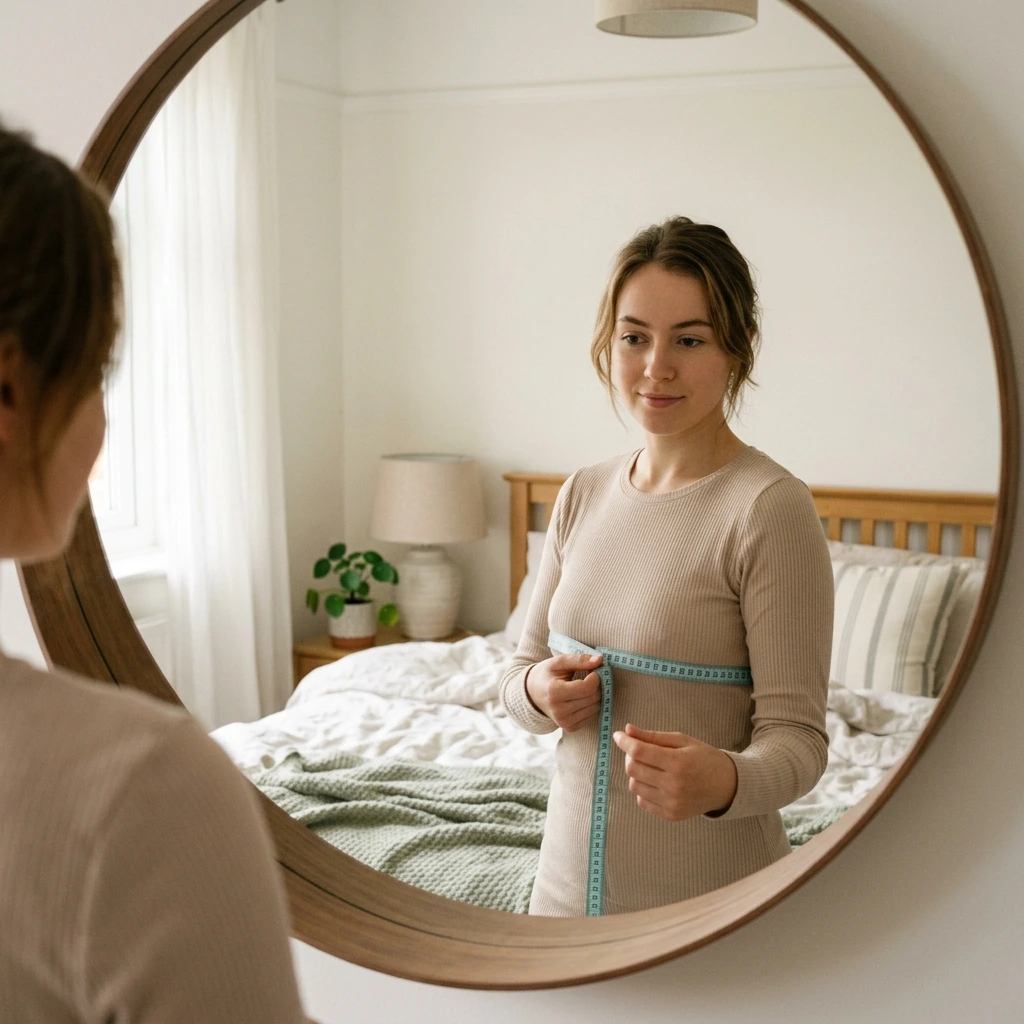
Here's the short version: measure your underbust snugly for your band, measure around the fullest part of your bust loosely, subtract one from the other, and every inch of difference is a cup size. Two numbers, a soft tape measure, and about a minute. The longer version below is where the accuracy lives — because most UK sizing guides quietly bake in an old rule that hands a huge number of women a band that's two sizes too big.
The quick answer
Wrap the tape measure around your ribcage, directly under the bust, and keep it snug and level — that number in inches, rounded to the nearest even, is your band. Then measure around the bust at its widest point without pulling tight. Subtract the band from the bust: a 1-inch difference is roughly an A, 2 inches a B, 3 a C, 4 a D, and so on up the UK scale. So a 34in bust over a 30in band is a 4in gap — a 30D. That's your starting size, not gospel. Any UK bra size calculator gives you the same maths; the fit check at the end is what turns a number into the right bra.
What you need before you start
You need a soft tape measure — the fabric kind used for sewing, not a metal builder's tape, which won't curve around your body. If you don't own one, a length of string marked against a ruler will do in a pinch. Measure in inches for UK sizing (centimetres work too, as long as you stay consistent), and do it in front of a mirror so you can see the tape sitting straight across your back.
Wear an unlined, non-padded bra or nothing on top at all. Padding adds volume that throws the bust number out, and a heavily moulded cup does the same. I always measure over a thin, unpadded bra rather than fully bare — it holds everything in its natural position, which gives a truer read than measuring a bust that's had no support and dropped. Stand up straight on a flat surface, arms relaxed by your sides, and you're ready.
How to measure your band size
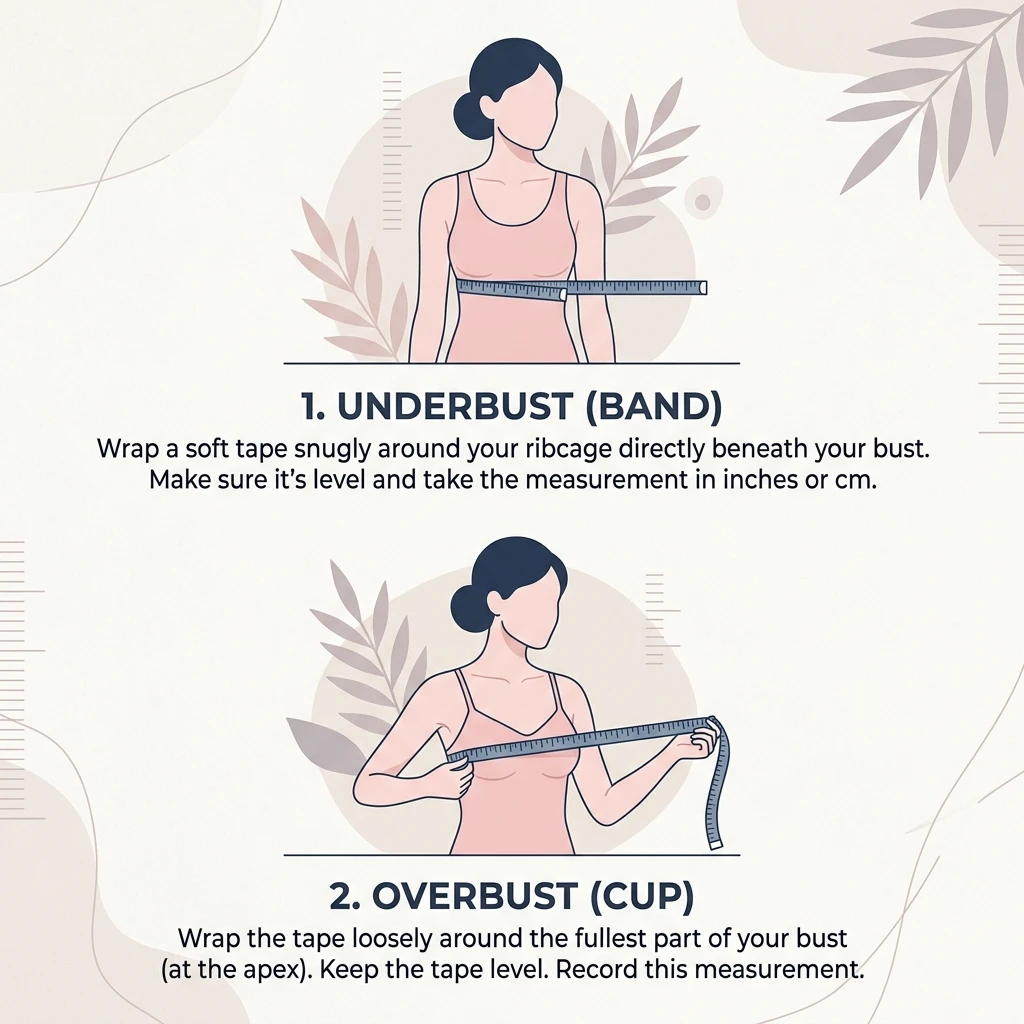
Bring the tape around your ribcage, right where a band would sit — under the bust, high on the back, not slipping down. Keep it firm and horizontal: a band's whole job is to grip, so a loose measurement here is the classic mistake. Exhale normally and take the reading. Don't suck in, and don't hold your breath either — you want your resting ribcage.
If you land on an odd number, round to the nearest even number, because UK bands run in evens (28, 30, 32, 34, 36 and up). That figure is your band size full stop — I'll come back to why you shouldn't be adding four to it. The band is doing most of the work in any bra, so getting this snug and honest matters more than the cup. A good band should feel like a firm handshake on the first hook, with room to tighten as the elastic ages.
How to measure your cup size
Now measure your overbust: run the tape around the fullest part of your bust, usually across the nipple line, keeping it parallel to the floor and loose enough to slide a finger under. Don't flatten yourself — the point is the natural, standing shape. If you're fuller or softer and the tape wants to dip at the front, lean forward to about 90 degrees, let everything fall into the tape, then read it. That leaning measurement catches volume a bolt-upright reading misses.
Take your bust number, subtract your band number, and read the gap. Each one inch of difference is one cup letter climbing the alphabet. Four inches over a 32 band is a 32D; six inches over a 34 is a 34F in UK terms. The maths is simple — the only thing that catches people out is which letters come next, which is a UK quirk worth its own section.
UK cup sizes explained
UK cups don't run cleanly A, B, C, D, E. After D they double up: the progression goes A, B, C, D, DD, E, F, FF, G, GG, H, HH, J and onward, adding a doubled letter between most single ones. So the size above a D is a DD, not an E — and the size above DD is E. Miss this and you'll under-cup yourself by a full size. Check our UK cup sizes chart for a full reference.
This is also why a US size doesn't map straight across. American brands collapse those doubled letters, so a UK DD is roughly a US E, a UK G is around a US H, and the gap widens the bigger you go. If you're shopping an American label or reading a chart that lists EU and US equivalents, check the conversion rather than assuming your letter travels. Most UK retailers — M&S, Next, Bravissimo, Panache — use this same doubled-letter system, so once you know your true UK size you can shop across them with confidence.
The "add 4" debate — which method actually works
Here's the bit the retailer pages tend to skate over. The old plus four rule tells you to measure your snug underbust and add 4 inches to get your band. It dates from the 1930s, when bras had far less stretch and needed the slack. With modern elastic, adding four usually gives you a band too big — it rides up at the back, stops gripping, and dumps the support onto your straps, which then dig into your shoulders. That shoulder migration of the weight is the tell-tale sign of a too-loose band.
The modern fitting approach — used by most specialist UK fitters — is plus zero: measure the ribcage snug, round to the nearest even, and wear that. No addition. If you've spent years in, say, a 38DD off an "add four" calculator and it never felt supportive, try a 34F or 34FF and feel the difference. Nine times out of ten the tighter band with a bigger cup is the fit you were missing. My honest advice: measure once with the plus-zero method, treat it as your baseline, and let the try-on decide the last half step.
How to check the fit once it's on
A tape gives you a starting point; your body gives the verdict. Hook a new bra on the loosest hook first, so you can tighten as the elastic relaxes over the months. Then run these checks. The back band should sit level across the back, not riding up between the shoulder blades — if you can pull it more than an inch or two away from your body, go down a band. Around 80% of the support should come from that band, not the straps.
Look at the cups: smooth and filled, with no gaping at the top edge (cup too big) and no spillage or quad-boob bulge over the front or sides (cup too small). Check the gore — the little bridge between the cups — which should tack flat against your breastbone. If it floats off, the cup's too small or the wrong shape for you. Finally the straps: you should be able to slip two fingers under them, and they shouldn't be doing the lifting on their own. If your straps carve grooves in your shoulders, that's a band problem, not a strap one.
Sister sizes and shopping across UK brands
Once you know your size, sister sizes are the trick that saves a shopping trip. Bras with the same cup volume sit in a diagonal: go a band up and a cup down, or a band down and a cup up, and you hold the same cup size while changing the back. A 34C, a 36B and a 32D are all roughly the same cup — just cut for different ribcages.
This matters because UK brands fit differently even at the "same" size. Panache, Freya and Elomi cut generously; a smaller label runs tight. If your usual size nearly fits but the band's a hair snug or the cup a touch shy, you can interchange to a cross-brand sister size instead of walking away. It's also how you rescue a bargain in the sale rack when your exact size has sold out.
When to measure yourself again
Your size isn't fixed for life, and that's the part people forget. Any real weight change shifts both band and cup — even a stone up or down can move you a size. Pregnancy and breastfeeding change you dramatically and repeatedly (see NHS guidance on maternity bras), and menopause tends to redistribute things again later. Re-measure whenever your body changes, and otherwise every six months or so as a habit.
Bras also wear out. When the elastic goes and the band starts to ride up no matter which hook you're on, the worn-out elastic has stopped gripping — that's a replacement, not a re-measure. As a rough guide, a well-cared-for bra lasts six months to a year of regular wear. If yours are older than that and never quite feel right, measure fresh before you assume you've changed size.
Frequently Asked Questions
Surveys put the UK average around a 36DD, though it's crept up over the years. That said, 'average' is meaningless for your fit — measure yourself rather than defaulting to it.
Need to check your measurements right now?
Use our free online UK Bra Size Calculator to calculate accurate band and cup sizes in seconds using cm or inches.
Calculate Bra Size Free