Bra Size Chart UK — Find Your Real Size in 2026
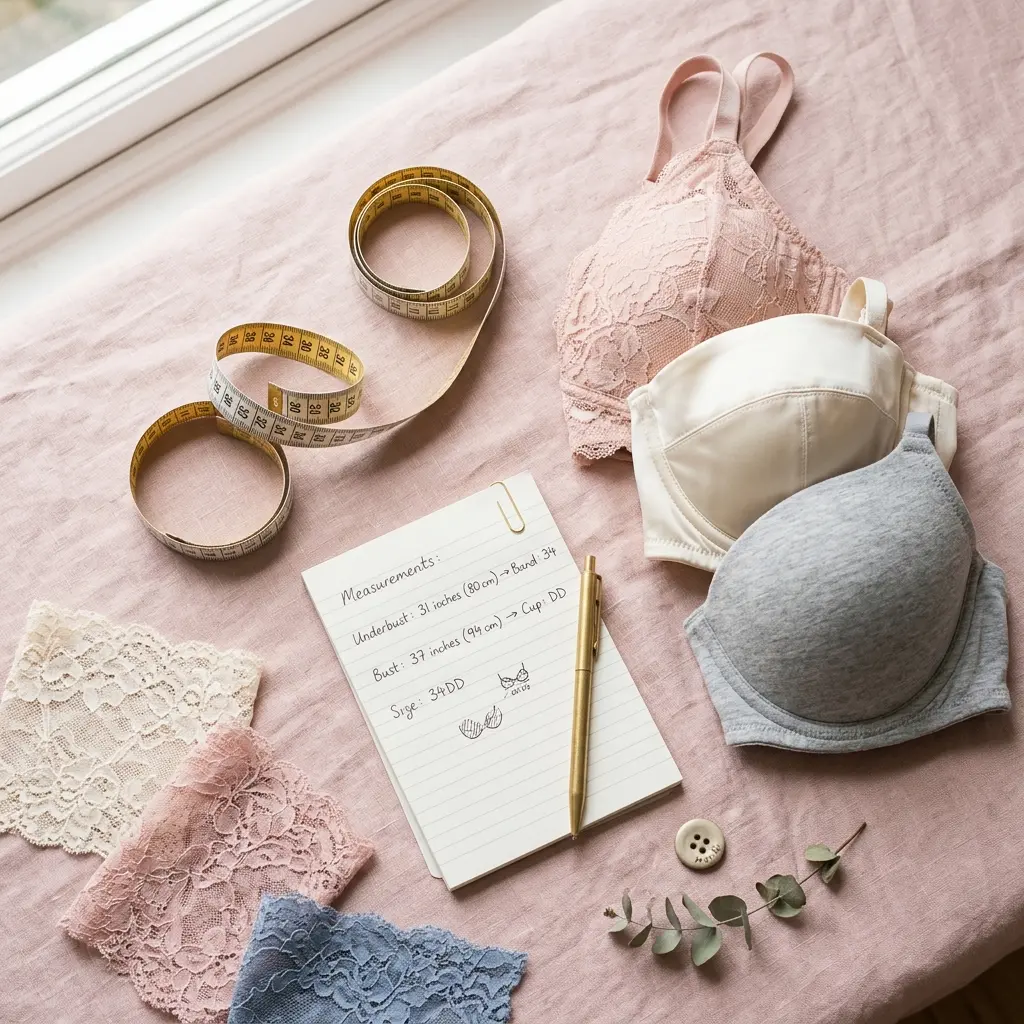
Most bra size chart UK searches end the same way: you find a table, you read it, and you still don't trust the answer. Usually because the number a shop assistant gave you and the number a calculator gives you are three band sizes apart. Both can't be right. This guide gives you the chart, then explains the fight going on behind it.
The quick answer — UK bra size chart (band + cup, inches)
Your size is two numbers pulled from two places on your body. Measure snug around your ribcage, directly under the bust — that's your underbust, and in UK sizing it becomes your band size. Then measure loosely around the fullest part. Subtract the first from the second. Each one inch of difference is one cup size.
That's the whole system. Everything else is a reference table.
UK band number runs in even steps: 28, 30, 32, 34, 36, 38, 40, 42, 44, 46. If your tape measure lands on an even number, that's your band. An odd number means rounding — and I'd round down rather than up, because bands stretch out within a few months of wear and a firm one still gives you support at the end of its life.
The cup letter follows the inch difference:
| Difference (inches) | UK Cup Size |
|---|---|
| Under 1 | AA |
| 1 | A |
| 2 | B |
| 3 | C |
| 4 | D |
| 5 | DD |
| 6 | E |
| 7 | F |
| 8 | FF |
| 9 | G |
| 10 | GG |
| 11 | H |
| 12 | HH |
| 13 | J |
| 14 | JJ |
| 15 | K |
Two things this chart won't tell you. First, cup volume isn't fixed to the letter — a 30F and a 38F hold wildly different amounts, because volume climbs with the band. Second, no measurement survives contact with a badly cut bra. The tape gives you a starting size range, not a verdict. If you shop in centimetres, multiply your inches by 2.54 and use the EU column further down. The fit is decided in the changing room.
How to measure your bra size at home (2 measurements, no adding inches)
You need a tape measure, a mirror, and about ninety seconds. No string required, though if you've lost the tape, wrap string around, mark where it overlaps, and lay it flat against a ruler or yardstick — you'll be accurate to a quarter inch, which is close enough.
Measure braless or in a non-padded, unlined bra. Padding reads as breast tissue and inflates the number. Bare skin or a thin t-shirt is best. For the underbust, pull the tape firm — snug against the ribs, not draped on top of them. It should sit level and parallel to the floor all the way round, which is what the mirror is for. Round to the nearest even inch; when you're between sizes, round down.
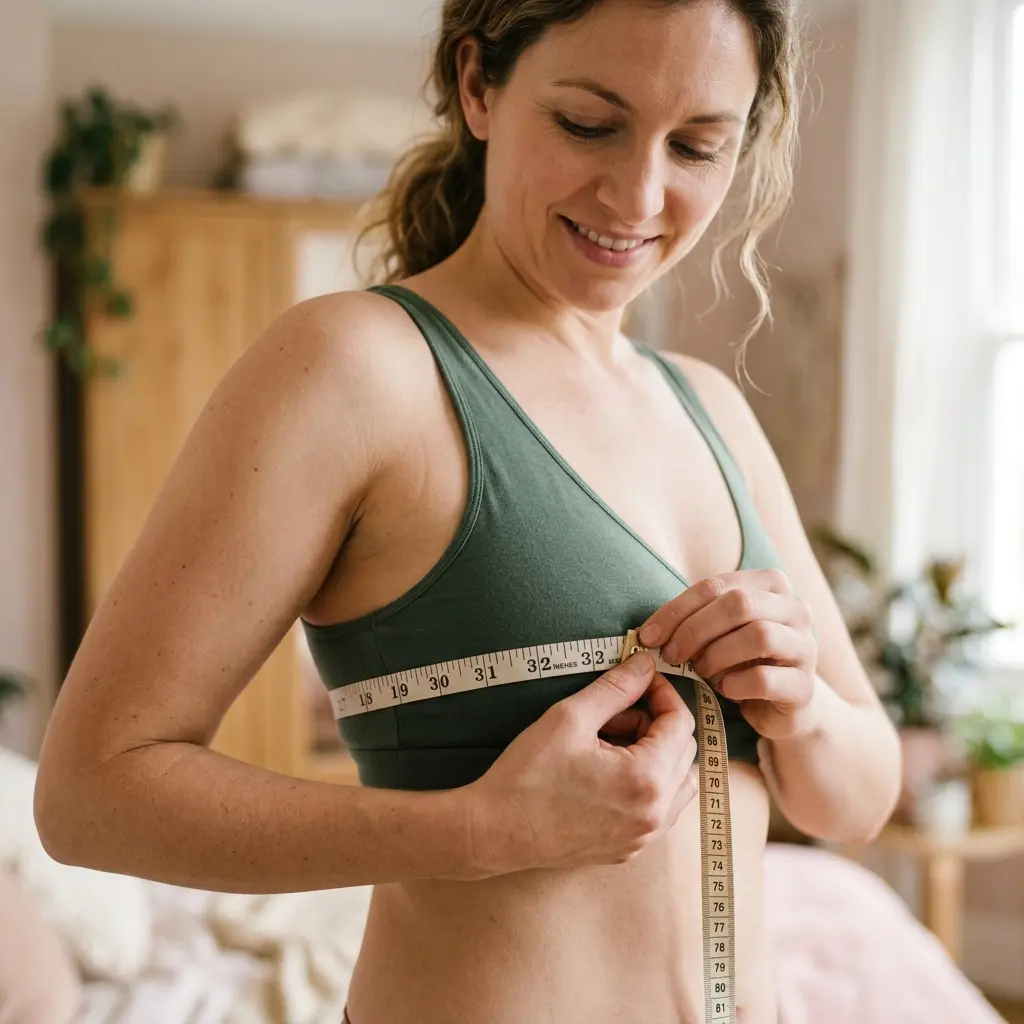
Now the bust. Tape loose around the fullest point, roughly nipple level, tape parallel again. If you're a C cup or above, don't do this standing upright with arms at side — tissue rides up toward the chest wall and you'll under-read yourself. Lean forward to about 90 degrees and let everything fall. Then subtract band from bust; the difference in inches is your cup.
What you don't do is add anything. The direct measurement — sometimes called the snug-measure method — is what modern elastic is engineered around. Every inch you add is an inch of stretch you're giving away.
Fasten a new bra on the loosest hook so you've got somewhere to go as it wears. And treat the result as a starting point for the try-on, not a fact about your body. I've watched people measure into a 32F, hate the 32F, and settle happily into a 30G. Bodies change too — after weight shifts, pregnancy, or nothing in particular. Re-measure every six months to twelve months. If you work in metric, a half centimetre of precision is plenty. Anyone chasing more accuracy than that is measuring the wrong thing; the next section explains why, and a sister size is usually the fix.
Why your M&S size and your calculator size don't match
Here's the answer nobody puts on page one: you're being measured by two different systems, and one of them is seventy years old.
The old one is the +4 method. Measure your ribcage, then add four inches if the number's even, add five inches if it's odd. Some versions say plus two. It comes from the 1950s, when bra elastic barely stretched and you needed the slack. Fabric technology moved on. The method didn't. Arnotts still spells it out in its fitting guide, and shoppers regularly report that a fit tool or in-store calculator has pushed them up a band or two. Marks & Spencer now hedges — its guide calls a tape reading a rough starting point and steers you toward a professional fitting with a lingerie stylist instead of a number.
So a woman with a 32-inch snug underbust measures herself at home, gets 32E, walks into a department store, and comes out with a 36B. Same body. Both sizes real, in the sense that both exist on a label. Only one of them supports her.
The tell is the loose band. A band that's four inches too big won't sit level — it starts riding up your back within an hour, which throws the support onto your straps, which is where the shoulder pain, the neck pain, and the red marks come from. Roughly 80% of women are said to be in the wrong size; the honest survey range is more like 70-85%, and the collection methods are inconsistent enough that I'd treat any precise figure with suspicion. The pattern underneath it isn't in dispute, though: band too big, cup too small. Almost always in that combination.
There's a second culprit, and it's not anyone's fault. Standardisation doesn't exist. A 34C from two brands can differ by a full cup, so the discrepancy between your measured size and your worn size may be pure retail label noise — some charts build in band ease, some don't. Which is also why "I've been a 34C since I was nineteen" is worth nothing. If it's been five years, it's a guess.
Do this instead. Measure yourself directly. Take the result and its sister size into a fitting room, and trust the mirror over both the tape and the fitter. A friend of mine was measured as a 30DD at a chain store, tried a 28E out of sheer stubbornness, and has worn nothing else since. Chase comfort and real support, not the letter. Then verify every year or so. Your band size and cup size are a fit outcome, not an identity — and the rounding is just arithmetic.
UK cup sizes in order — and why we have DD, FF, GG and HH
The UK sequence looks like a typo. It isn't. Written out: AA, A, B, C, D, DD, E, F, FF, G, GG, H, HH, J, JJ, K, KK, L, LL.
Every step is a one-inch increment in the gap between band and bust measurement. A five-inch difference is a DD. A six-inch difference is an E. A ten-inch difference lands on GG. Follow the alphabet straight through and you'd hit a wrong letter within two steps, because the double letter sizes — DD, FF, GG, HH, JJ — sit between the single letter ones. They exist for the fuller bust, where a plain A-to-Z progression would jump too coarsely. The step between an F and a G is small enough to matter. So British pattern-cutters split it.
The US divergence is where money gets wasted. American brands run DDD where we run E, and their letters shift again above that. Order a US "F" expecting a UK F and you'll get something closer to a UK E. Meanwhile the volume change across a cup letter isn't constant either — a 28G and a 38G share a letter and nothing else, since band size drives the actual capacity.
This is why the fuller-bust specialists are worth knowing by name. Bravissimo, Freya, Fantasie, Elomi, Panache and Curvy Kate all build on UK cup volume logic, with a gradual increase through the double letters rather than a shrug above D. If you're above a DD, that consistency is the single biggest reason to shop British brands — a UK G or H cut by Elomi will behave far more predictably than a generic G from a high-street label that stops caring after D. And yes, sizes above K, KK, L, LL exist. They're just harder to find on a Tuesday afternoon in Bluewater.
UK to US, EU, French and Australian conversion
Band converts cleanly. Cups don't. That's the sentence to keep in your head, because it explains every bad international order you've ever placed.
US and UK share the same inch-based band number — a 34 is a 34 in both. EU and Japan switch to centimetres, where a 34 becomes 75. France and Spain take the EU number and add fifteen — plus 15 — so a 34 band prints as 90. Germany follows the EU band table. Australia ditches numbers you'd recognise and uses dress-style bands: 6, 8, 10, 12. To convert a bust reading to centimetres, multiply by 2.54.
Now the cup table, which is where it falls apart. Letters match up to D, then the systems diverge. The US starts doubling — DD, then DDD — while the EU runs a straight alphabet. A US D is a UK DD is an EU E. A 36DD in the US reads as 80E in Europe. JP cups print letter-first (B75 rather than 75B) and tend to run a touch shallow; if reviews mention a shallow fit, size up a cup. India mostly borrows US labelling, though brand chart discipline is patchy.
Two labels that confuse people. A dual label like 32/70 is one band written twice — US/UK inches, then EU centimetres. A tag reading 165/90 isn't a bra size at all; it's Chinese sizing, height and chest in centimetres. And a retail label is a label, not a tape reading — French luxury lingerie houses print 90 on a 34-inch band without pretending your ribcage measures 90 of anything.
Use a conversion chart to get in the right postcode. Then use the brand's own conversion chart. When the two disagree, the brand wins. Every time.
Sister sizes: same cup, different band
A sister size is the same cup volume carried on a different band width. Learn this and you stop being trapped by one label.
The trick: go down a band and up a cup, or the reverse. A 34C, a 32D and a 36B all hold roughly the same volume — the cup is cut in proportion to the band it sits on, so shrinking the band by one step means growing the letter by one to keep the capacity. Fuller-bust maths works identically: 28H, 30GG and 32G are one equivalent cup wearing three different bands. So are 30DD and 28E.
When do you reach for it? When the cup is right and the band isn't. Band too loose — it rides up, you've hooked it on the tightest setting already — drop a band and add a cup. Band too tight in the ribs, cup otherwise fine? Up a band, down a cup. Do this before you touch the cup letter shift on its own, because changing only the letter changes the volume and you'll trade gaping for spilling without fixing the actual problem.
One caveat from the fitting room. A sister size is a fitting trick, not a law — the wire width and cup depth shift slightly at each band, so the alternative size may sit differently even at identical volume. Fasten on the middle hook to adjust as it wears, take both sizes into the try-on, and pick the one you forget you're wearing. Comfort is the whole test. A 32D that you notice all day is a worse bra than the 30DD you don't.
Where UK brands disagree with each other
Nobody at head office wants to say this out loud, so here it is: there is no standard. A 34F is not a 34F. It's a 34F at that brand, in that style, and the gap between two of them can cost you a full cup.
Start with what's even available. Bravissimo cuts D–L across bands 28–40 — it doesn't make an A cup, and doesn't want to. Marks & Spencer spans AA–K across 28–46, but not every letter exists in every style. Primark stops long before the top of the range. So does a lot of the high street. If you're a 30HH, half the brands in the country simply don't have a pattern for you, and being told "we don't do that size" is not the same as being told you've measured wrong.
Then there's cut. Within a single label, a full cup runs roomier than a plunge; a balconette sits differently again; a rigid fabric holds where a stretch lace surrenders. Freya tends to run generous in the cup, Panache firm in the band, Elomi deeper for projection. Fantasie is somewhere between. Curvy Kate and Cleo favour a different breast shape entirely — more forward projection, less width. A 34B at Triumph and a 34B at Wacoal are cousins, not twins. Gossard, Sloggi, Playtex, Pour Moi, PrimaDonna, Sculptresse, Shock Absorber and Wonderbra each carry their own house block, and there's no cross-brand standardisation committee coming to save you.
My practical advice, learned the expensive way: buy from a specialist or a multi-brand retailer, not a general clothing store. Bravissimo, Brastop, Boux Avenue, a good independent lingerie boutique — places where you can try four brands in one room. John Lewis and Next will fit you kindly; a dedicated fitter will fit you accurately. And always read the individual brand chart on the product page rather than the site-wide one. When the two contradict each other, which happens more than you'd think, the product page is closer to the factory.
Five things that ruin a home measurement (padded bra, sloped tape, wrong week of the month)
Measure badly and the chart can't save you. Five errors account for nearly every wrong number I've seen.
One: the padded bra. Foam adds projection the tape reads as breast tissue, and you'll over-read your bust by an inch or more. Measure on bare skin or in an unlined bra. Measuring over clothes — a jumper, a hoodie — has the same effect on your ribs.
Two: the sloped tape. If the tape arcs upward at the back, your underbust reads tight and your bust reads long. Check in a mirror that it's parallel on both sides. Three: the lazy hand. A relaxed tape at the ribcage over-reads by an inch, easily. Pull it snug and firm. And a C cup or bigger who measures upright rather than leaning forward will under-read the bust, because the tissue hasn't fallen yet — the classic cause of an "impossible" result where bust barely exceeds band.
Four: the wrong week. Your menstrual cycle moves your cup. Hormones swell breast tissue in the week before a period, and that fluctuation can be a full cup for some women. Measure mid-cycle and you'll get your baseline; measure on day 26 and you'll buy a bra that's loose for three weeks out of four. Pregnancy and breastfeeding change everything more dramatically, and weight gain or weight loss of even half a stone will shift your band.
Five: the stale size. The number you were given five years ago is not data. It's nostalgia. Re-measure twice a year, aim for quarter inch accuracy with a tape or a marked string and a ruler, and accept that you'll land somewhere slightly different each time.
How to tell your bra actually fits
The tape gets you into the changing room. This is the bit that decides whether the bra is right, and it takes about thirty seconds once you know what to look at.
Start with the underband, because it does most of the work — around 80% of the band support comes from there, not the straps. It should sit level all the way round, snug enough that you can slide two fingers under and no more. If it rides up at the back, it's too big. Fasten a new bra on the loosest of the hooks — the loosest hook today, the tightest hook in a year, the middle hook for most of its life. If the band restricts your breathing or leaves deep red marks, size up the band and down a cup.
Then the cups. Do the scoop: lean forward, reach into the cup, and sweep the tissue from your underarm forward — fitters call it scoop and swoop, and it's not optional. Now look. Wrinkling or gaping fabric means the cup's too big, or the projection is wrong for your shape. Spillage over the top, an overflow at the edge, a quad boob ridge under a t-shirt, or a side bulge by your arm all mean it's too small. Go up a cup, not up a band.
The centre gore — the panel between the cups — should be lying flat against your ribcage. If it floats, the cup is too small, full stop. Underwire should trace the root of the breast without poking, rubbing, or sitting on breast tissue. Wire on tissue is pain, and it's a sign the wire's too narrow for your shape rather than too big.
Finally, the straps. They're passengers, not drivers. Slipping straps usually mean a slack band or a large cup; digging into your shoulders means the band has quit and the straps are carrying the load. Try this: drop the straps off your shoulders. If the bra stays put and the cups hold, the band is doing its job. And an uneven bust is normal — nearly everyone has one. Fit the larger side, tighten the strap on the smaller one, and if the gap is significant, a fillet or a stretch-cup balcony style will even it out. A stretch cup forgives what a rigid one exposes. Comfort is not a bonus feature here. It's the entire diagnostic.
Frequently Asked Questions
Every six to twelve months, and sooner after pregnancy, breastfeeding, or any weight fluctuation. Re-measure at home between fittings — it's free.
Need to check your measurements right now?
Use our free online UK Bra Size Calculator to calculate accurate band and cup sizes in seconds using cm or inches.
Calculate Bra Size Free