How Should a Bra Fit? The 5-Point Fit Check

The short version: the band does the work, sitting level and snug around your ribcage; the cups fully hold you with no spillage and no gaping; the gore tacks flat to your breastbone; the underwire sits behind your breast tissue, not on it; and the straps just steady the whole thing without digging in. Get those five right and the bra all but disappears. Here's how to check each one — and the counterintuitive fix that solves most fit problems.
The quick checklist
Put a new bra on and run these five checks in order: band level and firm, cups smooth and filled, centre gore flat against your sternum, underwire encircling (not sitting on) your breast, straps snug but not load-bearing. Fasten it on the loosest hook first — a new band will stretch over the months, and you want room to tighten as it ages. If all five pass, you've got your fit. If one fails, it usually points straight to the size tweak you need, which is what the rest of this covers.
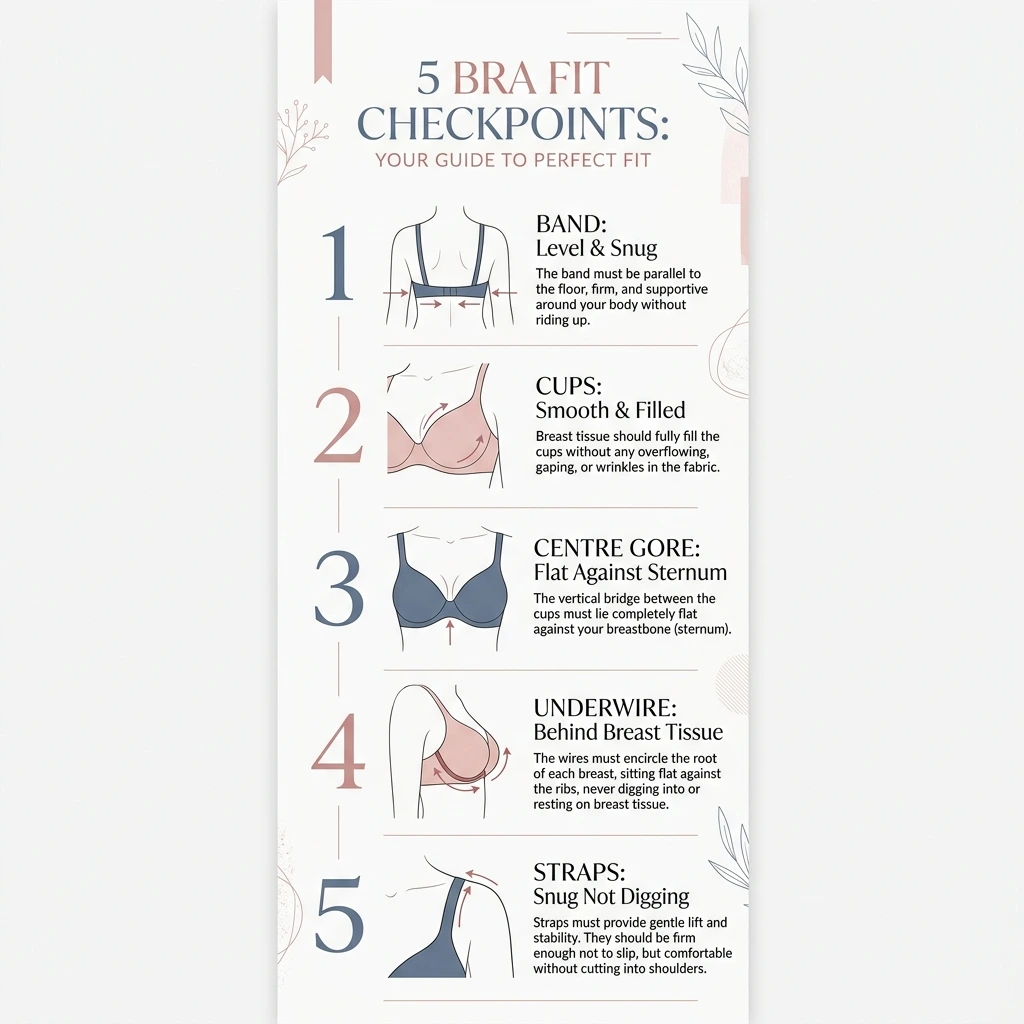
Start with the band — it does the heavy lifting
If you fix one thing, fix the underband. Around 80% of the support in a bra comes from the band, not the straps, so it needs to be genuinely firm around your ribcage. It should run horizontal the whole way round, parallel to the floor, and stay put when you raise your arms.
The tests are simple. If the band rides up into an upturned "U" at the back, or you can pull it more than an inch or two off your body, it's too loose — size down. If it's carving into you or you can't breathe comfortably, it's too tight, so size up. Remember you're checking all this on the first hook; the tighter hooks are there for later, when the elastic has relaxed. A firm band feels a touch unfamiliar at first if you've spent years in a loose one — that's normal, not wrong.
The cups — filled, smooth, no spillage
The cups should encase you completely, so your breasts fill the cup with a smooth line and no drama at the edges. Two failures to watch for. Spillage — breast bulging over the top or sides, the dreaded quad-boob — means the cup is too small; go up a cup. Gaping or wrinkling, where fabric stands away empty, means it's too big; go down a cup.
Before you judge it, lean forward and scoop all your tissue into the cup — a surprising amount lives out toward the armpit, and settling it forward changes the picture entirely. If it's smooth after that, you're there. If you need a bigger or smaller cup, change only the cup and keep the band the same, so you're testing one variable at a time.
The centre gore and underwire
The centre gore is the little bridge of fabric between the cups. On a well-fitting bra it should tack flat against your sternum. If it floats off your body, the cup is usually too small to let it settle; if it digs in or rubs, that often points to a band that's too small pushing everything forward.
The underwire should sit fully behind the tissue, encircling the breast and resting on your ribcage — never perched on top of breast tissue, which is uncomfortable and, over time, unsupportive. Poking or pinching at the front or side of the wire means either the cup's too small or the wire shape is wrong for you; some bodies simply need a wider or taller wire. Breast tissue runs back toward the armpit, so the wire needs room to sit around all of it.
The straps — and the falling-strap myth
Here's the counterintuitive bit that fixes more problems than anything else. If your shoulder straps keep falling down, the instinct is to blame the straps — but the real culprit is nearly always a band too loose. As a loose band rides up at the back, the straps go slack and slide off. The fix isn't tightening the straps; it's a smaller band.
The straps are only meant to supply about 20% support and keep the bra against your body — they should never be doing the heavy lifting. You want to slide two fingers under a strap comfortably: if you can't, they're too tight and you'll get red marks and digging; if you can lift them more than half an inch, they're too loose. Adjust the sliders on every new bra to your height, but if straps dig in even after adjusting, look back at the band. Nine times out of ten, that's where the answer is.
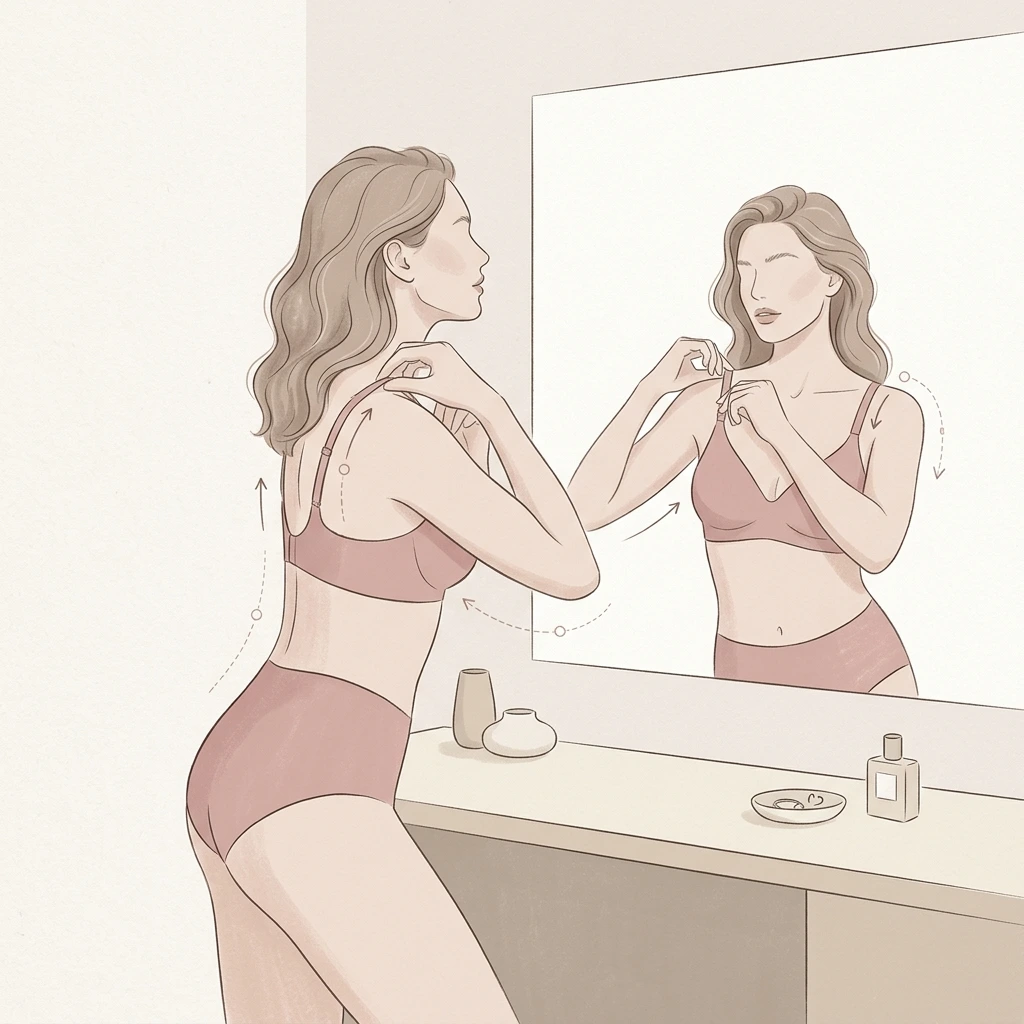
How to put a bra on properly (scoop and swoop)
Half of "bad fit" is really bad technique. Lean forward from the waist so your breasts fall into the cups. Fasten it — on the loosest hook — then, still leaning, use the opposite hand to scoop the breast tissue from your side and back and swoop it forward into the cup. Do it on both sides.
Stand up and settle everything, then check in the mirror: the gore should tack to your breastbone and the cups should look smooth. Finally adjust the straps to just-snug. This scoop-and-swoop takes ten seconds and genuinely changes how a bra fits — a lot of women think they've spilled out of a cup when they simply never moved their tissue into it.
The five signs your bra doesn't fit
Your body will tell you when something's wrong. Watch for rubbing and chafing (usually a loose, moving band, not a tight one), pressure marks and indents left on your skin, and the see-saw effect where a band riding up at the back drops the support at the front. Add in aches — back pain, shoulder pain, even headaches — and an uneven shape under clothes.
There's one honest tell above all: if you can't wait to take it off at the end of the day, or you feel restricted and constantly fidget with it, the fit is wrong. A correctly fitting bra should be something you stop noticing. Mild firmness from a new band is fine while it breaks in; genuine pain, pinching or numbness is not.
Why your size changes between brands and over time
Don't expect one number to hold everywhere. Sizing shifts with brand variation and even between styles within a brand, so a 34F in one label may be a 34FF in another — this is normal, and a sister size (band up/cup down, or the reverse) often rescues a near-fit. Judge by how the bra sits, not by loyalty to a number.
Your body changes too. Weight change, pregnancy, breastfeeding and ageing all move both band and cup, sometimes dramatically. That's why the same size that fit years ago may not now, and why a re-check is worth doing whenever your shape shifts.
When to re-measure or get a professional fitting
Measuring gives you a starting point, not a verdict — because brands vary, a tape measure can't tell you the final answer, only where to begin. Try on a couple of sizes around your measurement and let the five checks decide. As a habit, re-measure roughly every six months, or sooner after any body change.
If you're struggling, book a professional fitting at a fuller-bust or lingerie specialist. A good expert will get you into the right size and shape faster than any amount of solo trial and error — and many people who think they're "impossible to fit" simply haven't been measured properly. It's free at most shops and worth it. Bravissimo's fitting advice is a good place to start if you want to go fuller-bust specialist.
Frequently Asked Questions
The band should sit level and snug (it provides about 80% of support), the cups should fully contain your breasts with no spillage or gaping, the gore should lie flat against your breastbone, the wire should sit behind your tissue, and the straps should be snug without digging in.
Need to check your measurements right now?
Use our free online UK Bra Size Calculator to calculate accurate band and cup sizes in seconds using cm or inches.
Calculate Bra Size Free