G Cup Bra Size: UK vs US Measurements, Fit and Sister Sizes
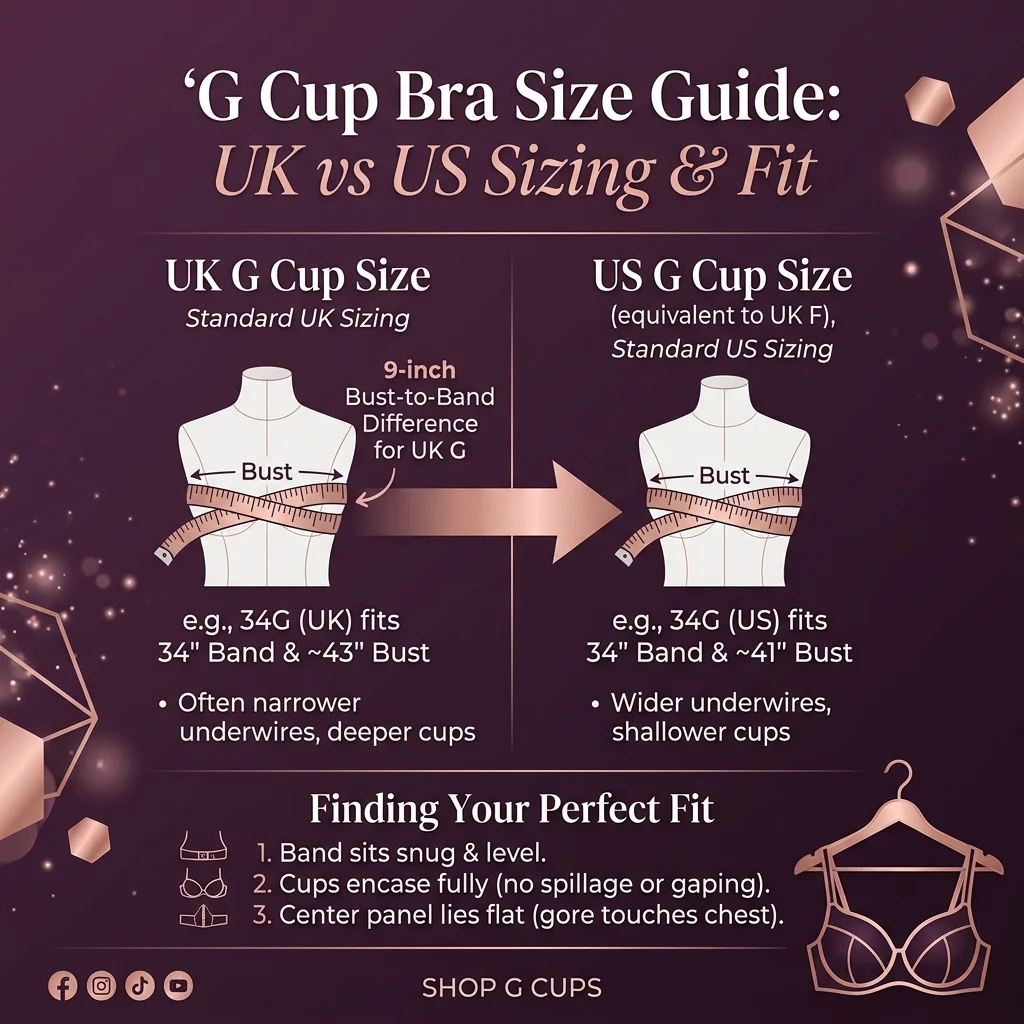
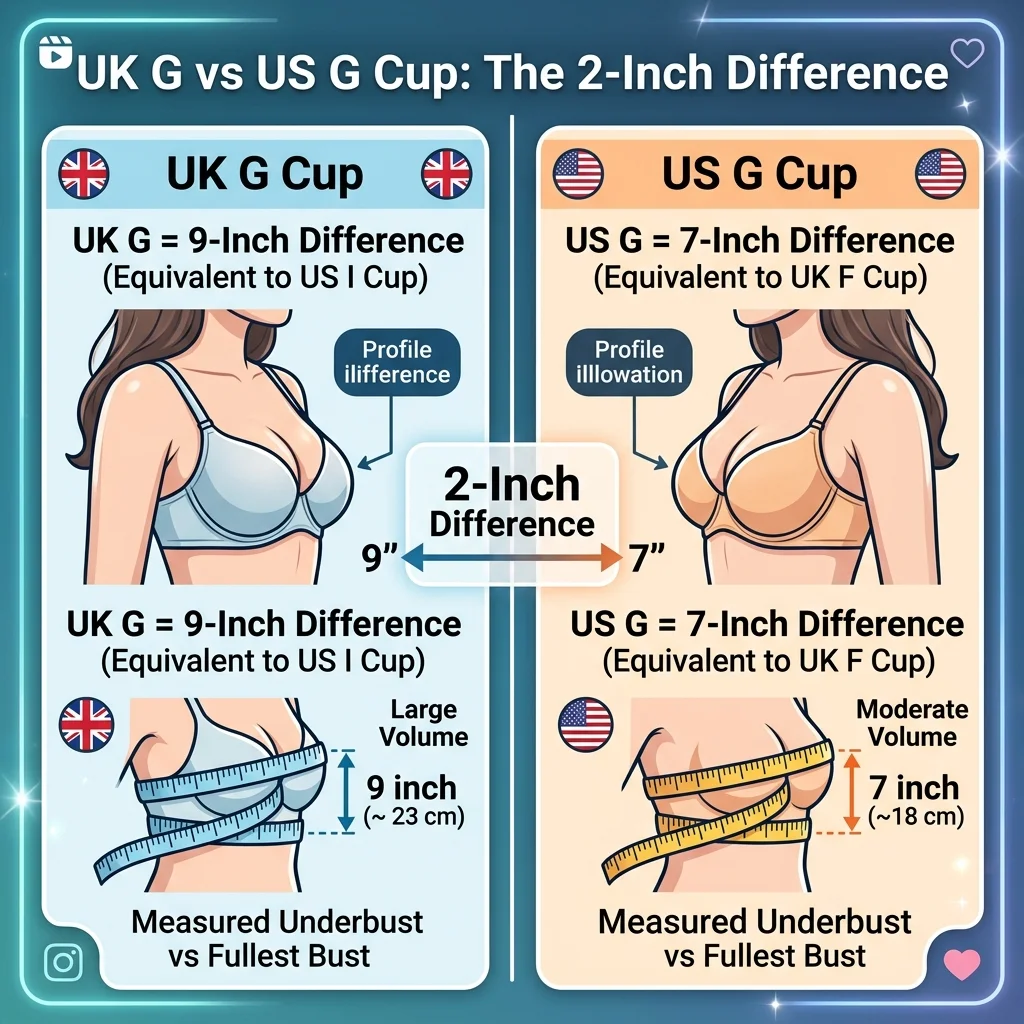
A G cup bra size is defined by the gap between your bust and your underbust — never by a fixed volume. In UK sizing that gap is roughly nine inches. In US sizing a G cup is roughly seven, which puts a UK G closer to a US I. Same letter, two different bras. Everything below assumes you know which system you're buying from.
What a G cup actually means
The single most useful thing to understand about this size is that the cup letter is a ratio, not a capacity. G describes the difference between your bust and your underbust in inches — nothing else. Which means a 30G and a 42G are both "G cups" and are nowhere near the same volume.
I've had this conversation in fitting rooms more times than I can count, usually with someone who has just been told they're a G and has gone slightly pale. The letter sounds enormous. Relative to a 30-inch ribcage, it isn't extreme at all — it's roughly the same proportion as a 38DD on a wider frame.
Cup volume scales with the band size because the cup is cut to sit on a bigger root and hold more tissue. Move up one band and keep the letter, and you've gained volume you may not have wanted. This is also why "I'm a G cup" tells a fitter almost nothing on its own, and why every sizing system insists on the number first.
The other half of the problem is the label. A brand can put G on a bra and mean 7 inches, 8 inches, or 9 inches of difference depending on which progression it uses. So the measurement gives you a starting point, and the brand decides what that starting point is called. At full-bust sizes — and G sits squarely in fuller bust territory in both systems — that gap between number and label is where most bad purchases happen. Projection and cup depth vary as much as volume does, but that's a fit conversation, not a sizing one.
UK vs US G cup — same letter, different volume
Bands are the easy part: a UK 34 band and a US 34 band are the same 34 inches. Cups are where it falls apart.
The US runs DD, then DDD (some brands write F), then straight into G, H, I, J, K. The UK uses double letters as half-steps: DD, E, F, FF, G, GG, H, HH, J. So the UK alphabet climbs more slowly, and by the time you reach G it has covered more ground. UK G ≈ nine inches. US G ≈ seven.
Run the conversion across and it lines up like this:
| UK cup | US cup | Approx. bust–underbust difference |
|---|---|---|
| DD | DD | 5" |
| E | DDD / F | 6" |
| F | G | 7" |
| FF | H | 8" |
| G | I | 9" |
| GG | J | 10" |
| H | K | 11" |
Two inches of difference between a UK G and a US G. That is not a rounding error — that's two full cup steps.
A quick way to sanity-check any chart: look at how a full-bust brand labels the same garment in both markets. Panache sports bras get listed as US 40H / UK 40FF and US 32K / UK 32H on American retail sites, which matches the table above exactly. If a chart tells you UK G equals US G, it's using a shortened UK progression that skips FF — some traditional high-street brands do, and their G is an 8-inch cup. Check the brand's own grading before you check anyone else's.
Practically: Panache, Freya, Elomi, Fantasie and Curvy Kate (all Wacoal Europe or UK houses) sell in UK letters even on US sites. Goddess and Glamorise sell in US letters. Buy a "G" from the first group and a "G" from the second group and you'll own two very different bras. That single mislabel is the most common reason a G cup order comes back.
How to measure for a G cup at home
Two numbers, one soft tape, five minutes. Do it in an unlined, non-padded bra or nothing at all — a sports bra or minimiser compresses the underbust and will send you a size wrong.
Underbust first. Wrap the tape directly under the breast, in the crease where it meets the ribcage. Pull it snug — firm against the body, not draped on it, and not so tight you can't breathe out. Keep it parallel to the floor all the way round. Round to the nearest even inch. That's your band.
Do not add four inches. The plus four rule is a leftover from an era of stiffer elastic and it is now the leading cause of a loose band. It's still printed on a surprising number of size charts. Ignore it.
Bust second. Measure across the fullest point, usually around nipple level, tape parallel to the floor, no compression. At G cup, take this leaning forward to about 90 degrees so the tissue falls naturally — measuring your standing bust upright will under-read you by an inch or more, and an inch is a whole cup letter.
Subtract the underbust from the bust. Nine inches on a 34 band gives you a UK 34G. Seven inches on the same band gives you a US 34G. Write down the raw difference in inches rather than the letter — it converts cleanly between systems, and the letter doesn't.
Two timing notes worth having. Avoid measuring in the week before your period; hormonal swelling can add up to half a cup and shift your cycle baseline. And re-measure every six to twelve months, or after any weight change — the size you were fitted into three years ago is a historical document, not a current one. Mid-cycle is your most honest reading.
G cup measurements by band size
Here's the arithmetic laid out. UK column assumes the standard nine-inch difference; US assumes seven.
| Band | Underbust (approx.) | UK G bust | US G bust |
|---|---|---|---|
| 30 | 29–30" | ~39" | ~37" |
| 32 | 31–32" | ~41" | ~39" |
| 34 | 33–34" | ~43" | ~41" |
| 36 | 35–36" | ~45" | ~43" |
| 38 | 37–38" | ~47" | ~45" |
| 40 | 39–40" | ~49" | ~47" |
| 42 | 41–42" | ~51" | ~49" |
| 44 | 43–44" | ~53" | ~51" |
Read down the column and the point makes itself. A 30G and a 44G share a letter and share nothing else — the cup depth, the wire width, the scaling of the whole garment shifts at every step. A 44G holds noticeably more than a 30G, which is why "what does a G cup look like" is an unanswerable question without the band attached to it.
Treat these as targets, not verdicts. Soft tissue, breast root width and shape all move the real answer around, and a half-inch either way at this size can decide between a bra that works and one that doesn't.
G cup sister sizes and when to use them
A sister size is a different band with roughly the same cup volume. Go down a band, up a cup letter. Go up a band, down a cup letter. The volume stays close; the band tension changes completely.
In UK sizing:
- 30G ≈ 28GG (firmer band) or 32FF (looser)
- 32G ≈ 30GG or 34FF
- 34G ≈ 32GG or 36FF
- 36G ≈ 34GG or 38FF
- 38G ≈ 36GG or 40FF
In US sizing the same logic applies with different letters — a US 34I sits between 32J and 36H.
The swap you'll actually reach for is down a band, up a cup. If the cups fit but the band rides up your back, 34G becomes 32GG. That's the fix, and at G cup it matters more than at smaller sizes, because a loose band hands the weight to your shoulders immediately.
The exchange works in the other direction too, when a band is genuinely painful rather than just unfamiliar — 34G to 36FF. Just know that going up a band widens the wire and stretches the cup shape sideways, which suits some breast roots and not others.
Where sister sizing earns its keep is stock. G cup availability thins out fast in unusual bands, and if a 32GG is sold out, the equivalent 34G may be sitting there in three colourways. Use it. Just don't use it permanently — a sister size is a workaround for band tension, not a replacement for your correct size, and wearing one long-term usually reintroduces the fit problem you were trying to solve.
How a G cup should fit — the five checks
Put the bra on the loosest hook — new bands stretch, and you want the tightening hooks in reserve. Then do the scoop and swoop: lean forward, reach into each cup, and pull all the tissue from under your arm and back forward into the cup. Half the fit problems people report vanish at this step alone.
Then check five things.
The band. Level across your back, not riding up toward your shoulder blades. You should get one finger underneath and no more. It should feel firm, and — this is the part nobody warns you about — it will feel tighter than what you're used to if you've spent years in a band that was two sizes too big.
The centre gore. The little bridge between the cups should tack flat against your sternum. Floating gore means the cups are too small or too shallow nine times out of ten.
The wire. It should sit behind the breast root, on your ribs, all the way around — not on tissue at the front and not stabbing into your armpit at the side.
The cups. Full, smooth, no spillage over the top and no wrinkle or gap at the bottom. A quad boob bulge at the upper edge means the cup is too small or the top edge is cut too closed for your shape.
The straps. They should be doing about a fifth of the work. Adjusted so they're secure and not slipping, but not carrying the load. At G cup, you also want real containment — each breast in its own cup, properly separated. That's encapsulation, and it's what stops the chafing and the uni-cup shape that compression-only garments create.
Common G cup fit problems and what to change
Most G cup complaints are one of about eight things, and almost all of them have a size or style answer rather than a "my body is wrong" answer.
Floating gore. Cup too small, too shallow, or too closed on top. Go up a cup, or move to a deeper style with a wide wire. If your breasts are close-set, a plunge with a lower gore will tack when a balconette won't.
Band riding up. The band is too loose. Down a band, up a cup — 34G to 32GG. This is the single most common G cup problem and the single easiest fix.
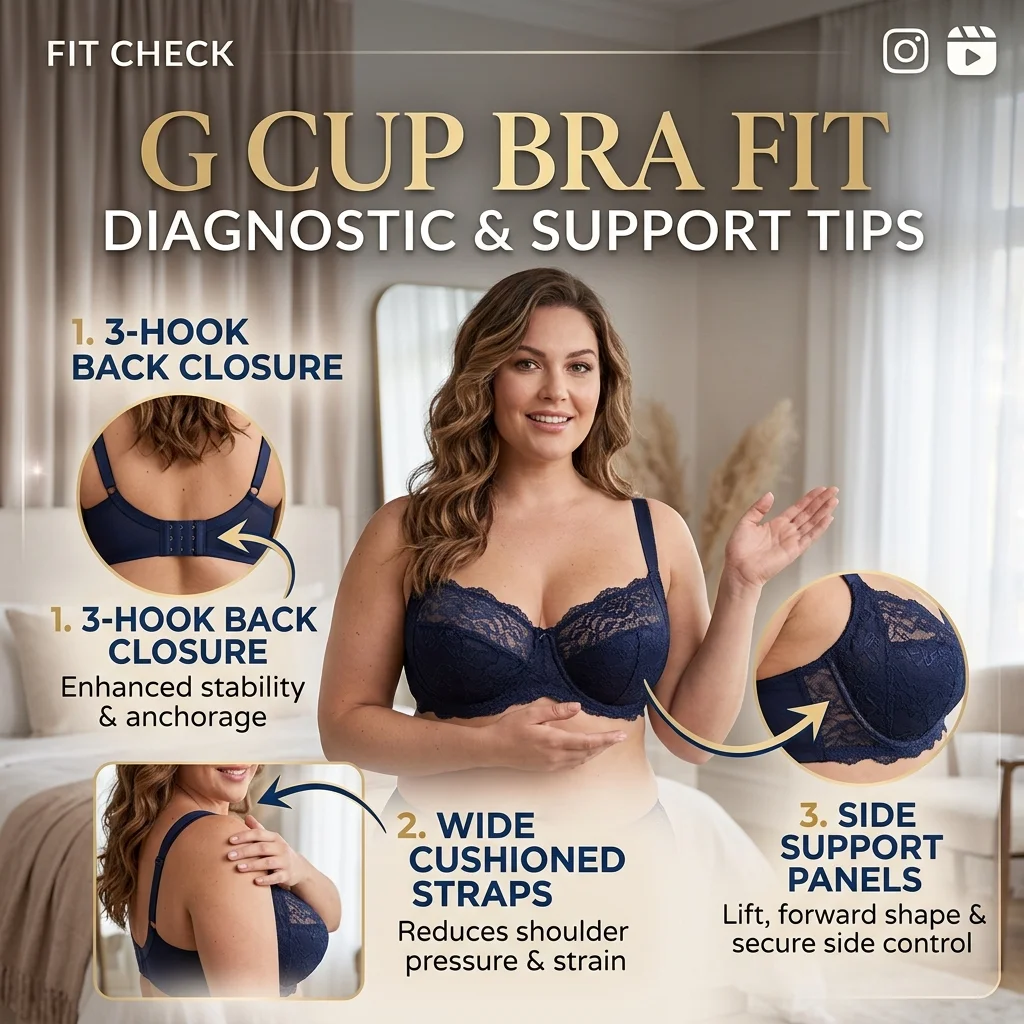
Side bulge under the arm. The narrow wire isn't containing your full root, or the wing is too short. Look for a side support panel — an extra vertical seam that pushes underarm tissue forward — and brands cut for projection.
Wire digging at the front or side. Wrong wire width for your root, not necessarily wrong size. Elomi and Freya cut wider; some Panache styles cut narrower. Try across brands before you try across sizes.
Strap grooves and shoulder pain. Almost always the band. See the next section.
Quad boob. Cup too small, or a shallow cup on a projected shape. Try a full cup rather than a half-cup style.
Uni-boob. Compression rather than encapsulation — common in cheap sports bras and bralettes cut for smaller sizes.
One side fits, one doesn't. Ordinary asymmetry. Fit to the fuller breast and adjust the smaller side with a strap tweak or a removable pad. Fitting to the smaller side pushes that wire outward and tilts the gore. If your breasts sit wide-set, expect to need a wider gore and a full cup — a plunge will float regardless of what size you buy.
Styles and brands that work at G cup — UK and US
At this size a bra is structural. The construction matters as much as the number on the label, and thin moulded fashion cups are usually the wrong tool — they flatten, spread tissue sideways, and push the gore off the chest.
What works: seamed cups, especially three-part cup builds, because seams create depth and lift that a single moulded piece can't. Side support panels for anyone carrying volume under the arm. Full cup and balconette styles for coverage and lift. Plunge only when your breasts are close-set and the cup has real depth behind the low gore. Wide, adjustable straps. Deep bands with four hooks rather than two.
By category: a t-shirt bra at G cup should be lightly lined and seamed rather than thickly foamed. A sports bra needs encapsulation plus a degree of compression for high impact work — Panache's underwired sports bra is the reference point most fitters reach for. Strapless is genuinely hard above an F and needs a very firm band, silicone lining and, honestly, low expectations. Minimiser, nursing and wireless styles all exist in this range now, and the wireless ones have improved enormously in the last few years.
UK shopping. Bravissimo (bands 28–40, cups D–L, and now owned by Wacoal since 2024) is the obvious starting point, with in-store fittings that are worth the trip. Panache covers bands 28–46 up to K; Freya 28–42 up to K; Elomi 32–48 and as far as LL; Curvy Kate and Sculptresse cover the fuller-frame end. Marks & Spencer and Boux Avenue carry G on the high street, though usually in a narrower band range.
US shopping. You have two routes. Buy the UK brands through American full-bust specialists — Breakout Bras, Bare Necessities, Nordstrom's full-bust range — and convert your letter first. Or buy US-graded brands like Goddess (bands 32–56), Wacoal and Glamorise, where a G means seven inches and no conversion is needed. Mixing the two without checking is how people end up with a drawer of nearly-right bras.
What a G cup weighs, and why shoulder pain is usually a band problem
Nobody puts this on a size chart, so here it is. Breast tissue is dense, and at G cup you're carrying real weight — commonly estimated somewhere around 1.5 to 3 kilograms for the pair, roughly 3 to 7 pounds, scaling up with band size. Those are practical fitting estimates rather than clinical figures; actual density varies enormously with age, hormones and body composition.
Here's what matters about that number. Your band is designed to carry 80 percent or more of that load. Your straps carry the rest. When people arrive with shoulder grooves, trapezius ache or persistent upper back pain, the instinct is to tighten the straps — and it works for about ten minutes before it makes things worse, because you've just moved more gravity onto two narrow points.
The real fix is almost always a firmer band. Go down a band and up a cup, keep the volume, and let your ribcage take the weight the way the garment intends. Alongside that: greater strap width, taller wing height at the side, and a cup shape that keeps tissue centred and forward rather than spread across your ribs.
If a properly fitted band doesn't resolve persistent pain, that's worth raising with a GP or physio rather than another bra purchase — posture, muscle tension and fit interact, and a bra can only solve the fit part.
Buying a G cup bra across borders
UK stock is deeper, US stock is closer to hand, and plenty of people end up ordering both ways. A few things save money.
Check the brand's own size chart every time, not a generic converter. Brand grading varies by a half cup within a single market, and a Freya G and an Elomi G are not interchangeable even though both are UK-sized.
Read reviews for the specific style, filtering for people in your band. At full-bust sizes, reviewers routinely report "runs shallow" or "band runs tight" and that intel is more reliable than the chart.
Factor in returns, shipping, and — for UK-to-US or US-to-UK orders — customs and duty, which can turn a good sale price into a bad one. Buy one bra to test the sizing before you buy three.
Finally, plan for stretch. Buy on the loosest hook and eye so the band has somewhere to go over its six-to-twelve-month life, and keep a band extender for the first fortnight only if a new firm band genuinely needs a break in period. If you're still on the tightest hook after two weeks and it feels loose, the band was too big to begin with.
Frequently Asked Questions
It depends entirely on the band. A 30G is a modest overall volume on a small ribcage; a 42G is considerably larger. G is a full-bust size in both systems, but it isn't rare — it's a standard stocked size across UK full-bust brands.
Need to check your measurements right now?
Use our free online UK Bra Size Calculator to calculate accurate band and cup sizes in seconds using cm or inches.
Calculate Bra Size Free