E Cup (DDD) Size Guide: Measurements, Fit & Sister Sizes
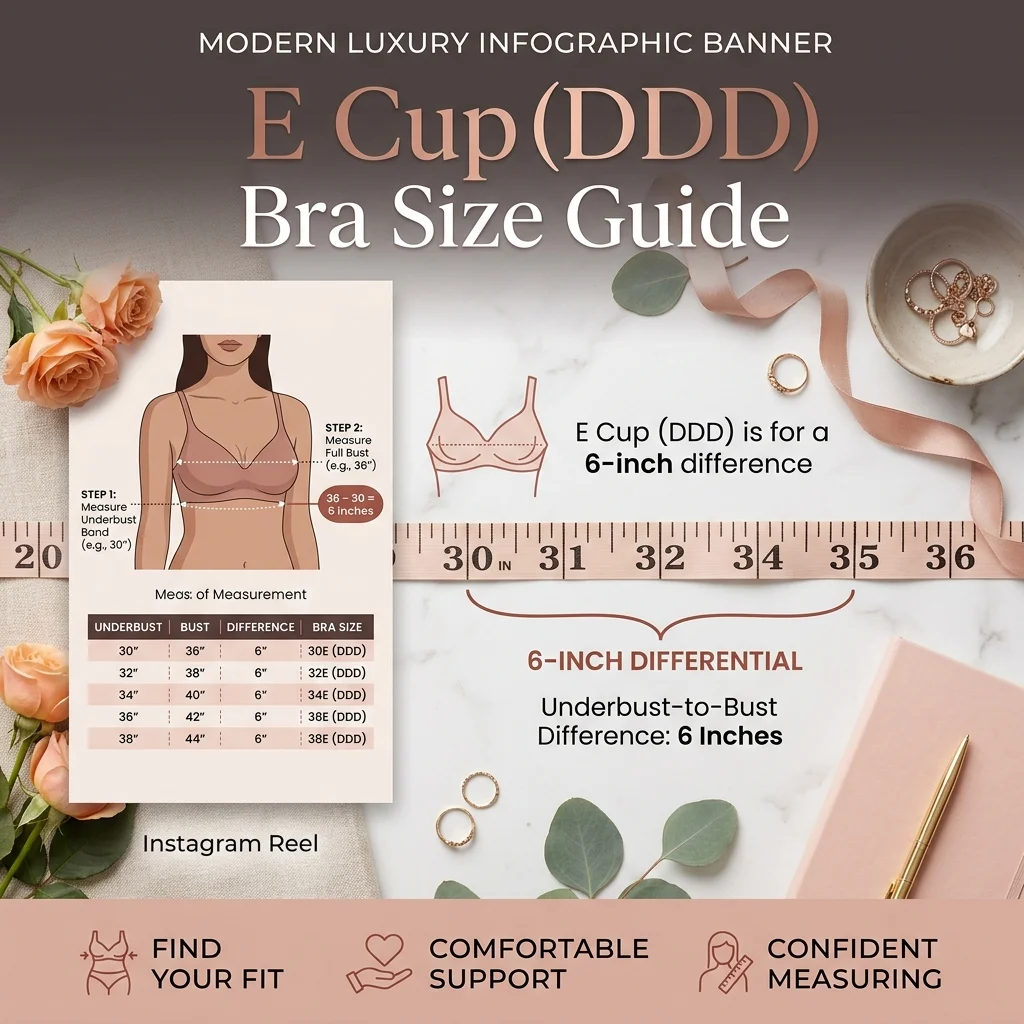
A DDD and an E cup size are the same thing — six inches of difference between your underbust and the fullest part of your bust. Only the label changes. American brands print DDD, British brands print E, and the bra underneath is identical. So if you were fitted 34DDD in New York and 34E in Nottingham, nothing about you changed on the flight home.
Key takeaways
- A DDD cup size and a UK E cup size are the same volume: a six-inch bust-to-band difference.
- Your band number measures your ribcage. The letter only measures the gap between ribcage and bust.
- Volume is relative — a 30E holds far less than a 38E, despite the shared letter.
- The sister sizes to a 34E are 32F and 36DD.
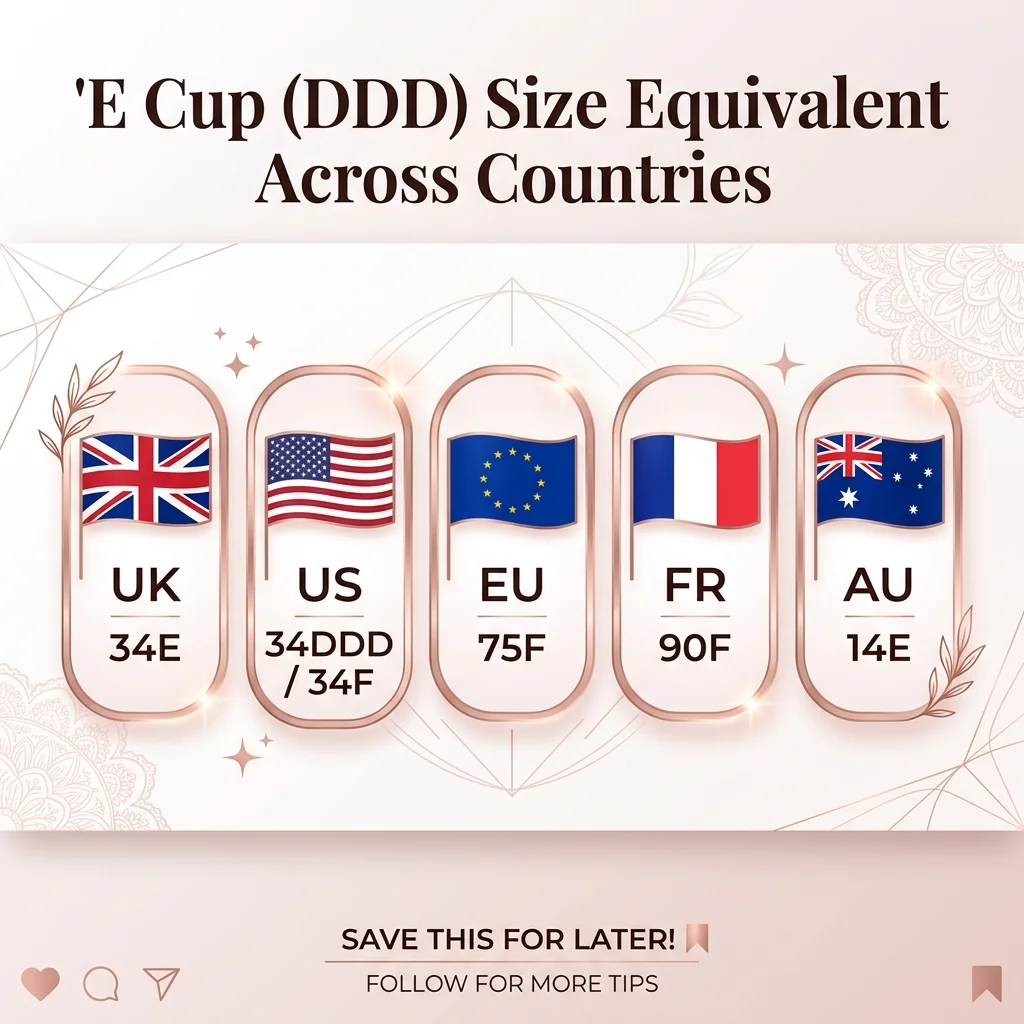
- UK 34E converts to US 34DDD/34F, EU 75F, French 90F and Australian 14E.
DDD and E cup size: the same bra, two systems
British and American sizing run in lockstep until the fifth cup, then split. Both systems agree that A is one inch of difference, B is two, C is three, D is four, and DD is five. At six inches they part company. Britain carries on into single letters — E, F, FF, G, GG. America stacks another D on the pile and calls it DDD.
Same bra. Same volume. Different alphabet.
Why the split causes so much trouble
Because it only affects sizes above DD, and those are exactly the sizes where fit gets unforgiving. Buy a 34DDD from a US site expecting it to be bigger than a 34E and you'll get the same garment. Buy a 34F from a US brand and it's also the same, since some American labels use F where others use DDD. Meanwhile a British 34F is a full inch larger.
The rule to hold onto: US DDD = US F = UK E. Above that, US G roughly equals UK FF, and the two systems drift further apart the higher you go.
How to read the label you're holding
Check where the brand is based before you trust the letter. Panache, Freya, Fantasie, Curvy Kate and Bravissimo are British and use UK sizing. Marks & Spencer, John Lewis and Boux Avenue do too. If the size run on a website goes D, DD, E, F, FF, G, you're in UK sizing and an E cup size means six inches. If it goes D, DD, DDD, G, you're in American sizing and DDD is your equivalent.
E cup size measurements in inches and cm
Two numbers give you a bra size, and they're taken differently.
How to measure properly
Wear a non-padded bra or nothing at all, and use a soft tape.
Underbust: wrap the tape around your ribcage directly beneath the bust. Pull it firm — firmer than feels polite. Breathe out. Round to the nearest even number and that's your band. Some UK retailers still add four inches to this figure, which is why the high street and specialist fitters can put you two band sizes apart on the same body.
Full bust: stand upright, tape level all the way round, resting lightly across the fullest point. Don't flatten anything. Don't hold your breath. Overtightening here is the single most common measuring error, and it's how a genuine F gets sold an E cup size that will never sit right.
Then subtract. Bust minus band, in inches. Six inches means an E cup, and it's the same six inches whether the number in front is 30 or 40.
E cup size measurement chart
| UK size | Snug underbust | Underbust (cm) | Full bust | Full bust (cm) |
|---|---|---|---|---|
| 30E | 29–30" | 74–76 cm | 36" | 91 cm |
| 32E | 31–32" | 79–81 cm | 38" | 96.5 cm |
| 34E | 33–34" | 84–86 cm | 40" | 101.5 cm |
| 36E | 35–36" | 89–91 cm | 42" | 106.5 cm |
| 38E | 37–38" | 94–96.5 cm | 44" | 112 cm |
| 40E | 39–40" | 99–101.5 cm | 46" | 117 cm |
Treat these as a starting point rather than a verdict. Breast tissue is soft and compressible, tape measures are blunt instruments, and two people with identical numbers can need different bras entirely.
What an E cup size actually looks like
There isn't one answer, and the question hides a false assumption — that a cup letter describes a size. It describes a ratio.
Volume is relative to the band
A 30E and a 38E share a letter and share almost nothing else. The cups on the 38E hold substantially more, because cup volume grows as the band grows even when the letter stays put. This is why "E cup" as a standalone description tells you very little, and why the tabloid shorthand of treating single letters as a scale is nonsense.
On a UK frame, a 32E or 34E typically sits on a dress size 10–14 with a proportionally full bust. A 38E or 40E sits on a broader ribcage where the same six-inch difference reads as less dramatic against the overall frame.
Shape matters more than the letter
Two people can both measure a perfect E cup size and need completely different bras. Some are full at the top of the breast, some full at the bottom. Some project forward, some spread wide across the chest. Some sit close together, some are set wide with a broader gap at the sternum.
That's the variable most size charts ignore, and it's the reason a style that fits one E cup beautifully gapes on another. Once you're past DD, shape stops being a detail and starts being the whole game.
How an E cup bra should fit
The fundamentals don't change with cup size. What changes is how quickly you feel it when they're wrong.
The band: Fasten on the loosest hook when the bra is new. It should sit level all the way round — a horizontal line, not a curve creeping up your back. Two fingers underneath and no more. At an E cup size the band is carrying roughly 80–90% of the weight, so a loose band doesn't just feel wrong, it transfers the entire load to your shoulders.
As the elastic softens over six to twelve months, work inward through the hooks. That's what the extra rows are for.
The wires and centre gore: The underwire should trace the natural root of the breast and sit flat on your ribcage behind the tissue, never on top of it. If a wire is resting on breast tissue at the side, the cup is too narrow for your shape — a different style, not a different size.
The centre gore between the cups should tack flat against your sternum. Any daylight there almost always means the cup is too small, even when everything else feels roomy. It's the most reliable single fit check there is.
The cups: Smooth, with no wrinkling and no overspill. Wrinkling at the top edge means too much cup; a bulge over the top or at the underarm means too little. Then do the scoop-and-swoop — lean forward, reach into each cup and bring the tissue from your underarm and back into the front. Half the fit faults people report at E cup size disappear the moment they do this properly.
The straps: Adjusted last, and never doing the heavy lifting. If they're leaving grooves in your shoulders, the band is too loose. Wider straps and leotard backs help at this size, but they're comfort features, not support ones.
E cup size sister sizes
A sister size holds the same cup volume in a different band. It's the tool for when the cups are right but the band isn't — and it stops you guessing blindly.
The rule: Go down a band, up a cup. Go up a band, down a cup. The volume stays constant while the frame changes.
| Your size | Down one band | Up one band |
|---|---|---|
| 30E | 28F | 32DD |
| 32E | 30F | 34DD |
| 34E | 32F | 36DD |
| 36E | 34F | 38DD |
| 38E | 36F | 40DD |
| 40E | 38F | 42DD |
When to reach for one
If your E cup size rides up at the back, drop a band and go up a cup — a 34E becomes 32F. If the band is genuinely painful and marking your ribs, go the other way: 34E becomes 36DD. That second one links the two most common UK sizes on the high street, and it's why so many people bounce between 36DD and 34E without either feeling quite right.
Sister sizing is a lateral move, not an upgrade. If the cups were wrong to begin with, it won't fix them.
Signs your E cup size is wrong
- Band riding up your back. The most frequent fault by a wide margin, and the answer is a smaller band with a bigger cup, not a bigger band.
- Overspill at the top or the underarm. Cup too small — try the next letter up before abandoning the style.
- Wrinkling or gaping in the cup. Cup too big, or a shape mismatch. Test with the scoop-and-swoop first.
- The gore floating off your sternum. Cup too small, nine times out of ten.
- Straps sliding off or digging in. A band problem wearing a strap disguise.
- Wire poking under your arm. Wrong wire width for your root — you need a different cut, not a different E cup size.
- Red marks after a few hours. Normal marks fade in minutes. Deep grooves that last mean something's wrong.
Best bra styles for an E cup size
Three-section cups are the workhorse of fuller-bust design — separate panels seamed together to lift and shape rather than just contain. Freya, Panache and Fantasie build most of their range this way, and they hold up better at an E cup size than a single moulded piece.
Balconette and side-support styles push tissue forward and inward rather than letting it drift under the arm. Best pick if you're wide-set or spreading sideways.
Full-cup bras give the most coverage and the most stability, and they've stopped looking like something from a hospital shop.
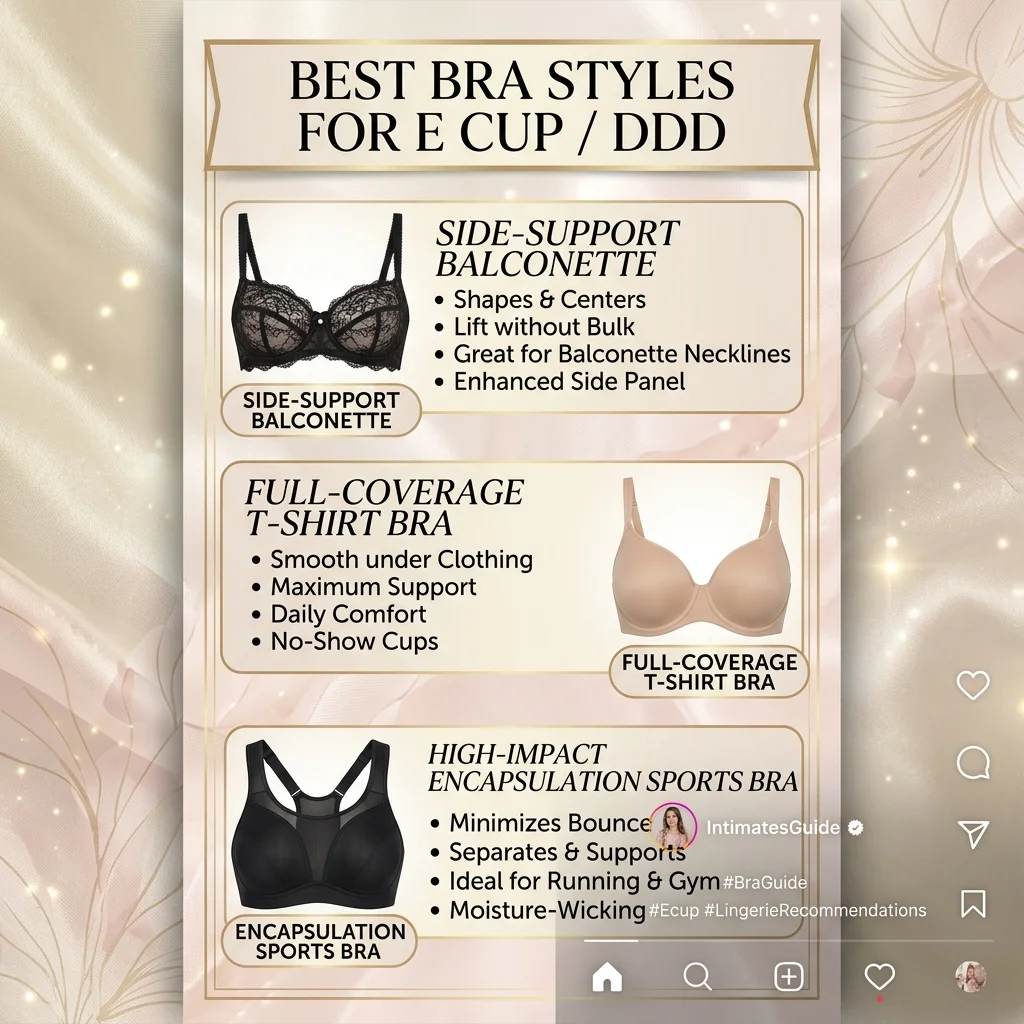
Moulded T-shirt bras work under fitted knitwear but run shallow — check the top edge for overspill before you commit. Look for ones specifically cut for D+ rather than a scaled-up small-cup pattern.
Plunge styles suit you if you're fuller at the bottom of the cup and want a lower neckline. Less useful if you're shallow up top.
Sports bras need encapsulation, not compression. Flat compression styles just squash — at this size you want separate cups and a firm band. Panache and Shock Absorber are the reliable UK options.
Do not assume your E cup size carries between brands. It won't. A 34E in one label can run a full cup off another, and the fitting rooms at Bravissimo, John Lewis and M&S will each hand you something different.
E cup size conversions: UK, US, EU and Australia
| UK | US | EU | France / Spain | Australia |
|---|---|---|---|---|
| 30E | 30DDD / 30F | 65F | 80F | 10E |
| 32E | 32DDD / 32F | 70F | 85F | 12E |
| 34E | 34DDD / 34F | 75F | 90F | 14E |
| 36E | 36DDD / 36F | 80F | 95F | 16E |
| 38E | 38DDD / 38F | 85F | 100F | 18E |
European sizing has no double-letters at all, so the UK's DD becomes an EU E and the UK's E becomes an EU F. Every UK letter above D shifts up one in the European run. French and Spanish sizing uses the same letters as the EU but adds 15 to the band number.
Not sure you're in the right size? Take five minutes with a tape measure using the method above, then check your result against the sister size chart before you buy anything.
Frequently Asked Questions
Yes. Both describe a six-inch difference between underbust and full bust. DDD is the American label and E is the British one for the identical cup volume.
Need to check your measurements right now?
Use our free online UK Bra Size Calculator to calculate accurate band and cup sizes in seconds using cm or inches.
Calculate Bra Size Free