36DD Bra Size Explained: UK Measurements, Fit & Sister Sizes
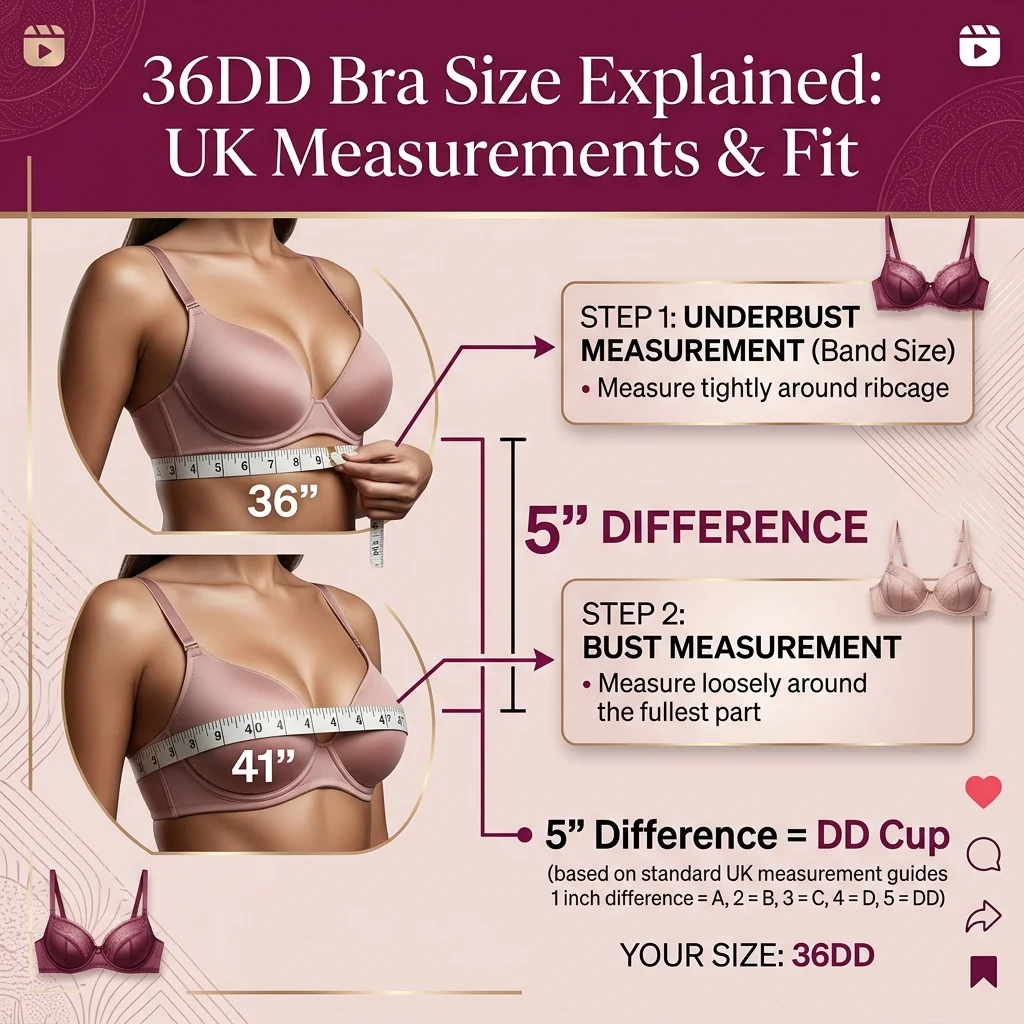
A 36DD bra size in UK sizing means a 36-inch band with a five-inch difference between your underbust and your fullest bust — roughly 41 inches around the bust. It's one of the most-sold sizes in Britain and one of the most frequently worn wrong, usually because the band is too big and the cup too small. This guide covers the exact measurements, how the fit should feel, every sister size worth trying, and how a 36DD bra size converts abroad.
What a 36DD bra size means in UK sizing
Two characters doing two entirely different jobs. The 36 is your band size — the measurement around your ribcage, directly under the bust — and that band is carrying somewhere around 80–90% of the support. The DD is your cup size, and here's the part that trips people up: a cup letter is not a fixed volume of breast tissue. It describes the difference between your ribcage and your bust.
The UK cup run goes A, B, C, D, DD, E, F, FF, G, GG, H, HH, J, JJ, K. Each letter represents one inch of difference, so DD sits five inches above the band. That's why a 36DD bra size holds noticeably more volume than a 30DD, despite the identical letter — the cup grows with the band. Two women in the same cup letter can have very different-looking busts.
One thing that's genuinely useful to know if you shop British sites: DD here is a real, standalone size, not a marketing "D-plus". Specialist fuller-bust labels — Panache, Freya, Fantasie, Curvy Kate — treat the 36DD bra size as the entry point to their properly engineered ranges, with deeper cups, wider wires and three or four hooks instead of two. Buying the same size from a general high-street range often gets you a shallower cup and a weaker band.
How to measure for a 36DD bra size at home
You need a soft tape measure, a mirror, and either a non-padded bra or nothing at all. Padding and moulded foam will skew both numbers.
Step one — the underbust. Stand upright, breathe out normally, and wrap the tape around your ribcage directly under the bust. Pull it firm. It should feel snug enough that it won't slide down if you let go. Note the number in inches.
Step two — the full bust. Keep the tape level all the way around and take it across the fullest point, usually at nipple level. This one stays loose. Don't compress the tissue. If you're soft or full-on-bottom, take a second reading while leaning forward at 90 degrees and use the larger of the two.
Step three — the maths. Round your underbust to the nearest even number for your band. Subtract that band number from your bust measurement, and each inch of difference is one cup letter up the UK run. A five-inch difference on a 36 band gives you a 36DD bra size.
Two methods are still circulating in the UK, which is the single biggest source of confusion. The traditional high-street method adds four or five inches to the underbust before rounding; the modern fitting-room method used by Bravissimo and most specialists adds nothing. Both can land at a 36DD bra size from different starting numbers, so always check which chart a retailer is using before you order.
36DD bra size measurements in inches and centimetres
| Measurement | Inches | Centimetres |
|---|---|---|
| Underbust — modern/snug method | 33–35" | 84–89 cm |
| Underbust — traditional +4 method | 31–32" | 79–82 cm |
| Full bust | 40.5–41.5" | 103–105 cm |
| Bust-to-band difference | 5" | approx. 12.5 cm |
| UK band | 36 | EU 80 |
| UK cup | DD | EU E |
Treat those as ranges, not gospel. Ribcages vary in shape as well as circumference, and a rounded ribcage sits differently in a band than a flat, broad one. If your underbust reads 35.5" you're between bands, and the honest answer is to try both the 36DD bra size and its 38D sister before deciding.
Is 36DD a big bra size? What it looks like on a UK frame
Above average, yes. Enormous, no — and the tabloid shorthand around "DD" does real damage here.
Because the band is set by your ribcage rather than your bust, a 36DD bra size typically sits on a UK dress size 12–18 frame with a proportionally full bust. Five inches of difference reads as full and defined, projecting forward rather than spreading sideways. On a broader back it can look relatively modest; on a shorter torso the same size looks considerably fuller. Same label, different silhouette.
The comparison that makes the whole system click is volume across bands. A 32DD, a 36DD and a 40DD share a letter and share almost nothing else — the 36DD bra size holds meaningfully more than the 32DD two bands down, and less than the 40DD two bands up. The figure often quoted in British retail research, that the average UK bra size has drifted from 34B decades ago towards something near 36DD today, reflects changing ribcage measurements at least as much as changing bust size. Treat that stat as retailer-reported rather than clinical.
How a 36DD bra size should fit: the five-point check
Run these in order every single time you try one on. Skipping straight to "does it look nice" is how badly fitting bras get bought.
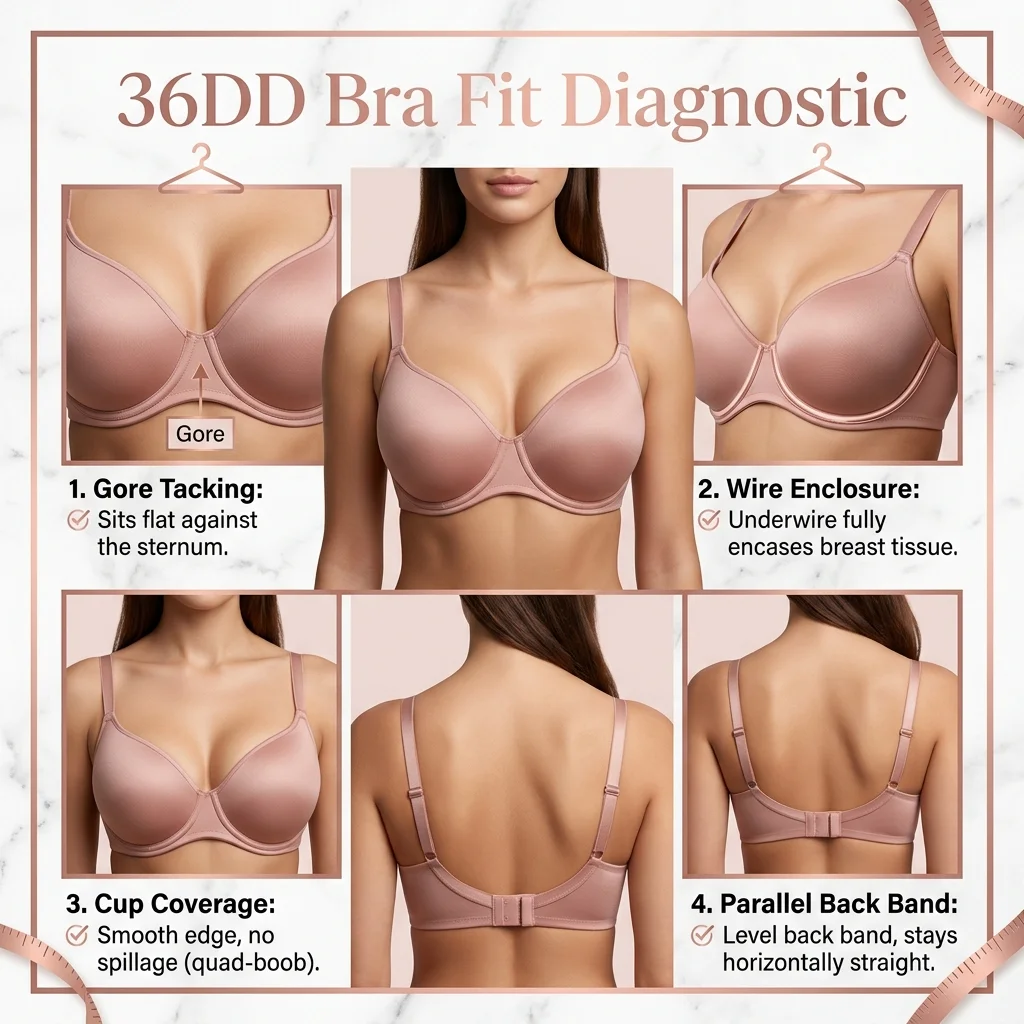
The band. Fasten it on the loosest hook. It should sit horizontally across your back, level with the underband at the front, and you should get two fingers under it and no more. If it rides up towards your shoulder blades, it's too big — that's the single most common fault in a 36DD bra size, without exception. Bands stretch over six to twelve months, and the tighter hooks exist to take up that slack later.
The wire. The underwire should encircle the whole breast and sit flat on the ribcage behind the tissue, not on top of it. Poking into the underarm usually means the wire is too narrow for your root, not that the size is wrong.
The centre gore. The piece between the cups should tack flat against your sternum. If it floats away from the chest, the cup is too small — even when the 36DD bra size feels perfectly roomy everywhere else. This is the check most people have never been taught.
The cups. Smooth, with no spillage over the top edge or at the underarm, and no wrinkling or gaping along the seams. Do the scoop: lean forward, reach into each cup and bring all the tissue forward from the side and underneath, then stand up and look again.
The straps. Adjusted last, and never doing the heavy lifting. Two fingers of give. Red grooves on your shoulders at the end of the day mean the band isn't holding its share.
36DD sister sizes chart
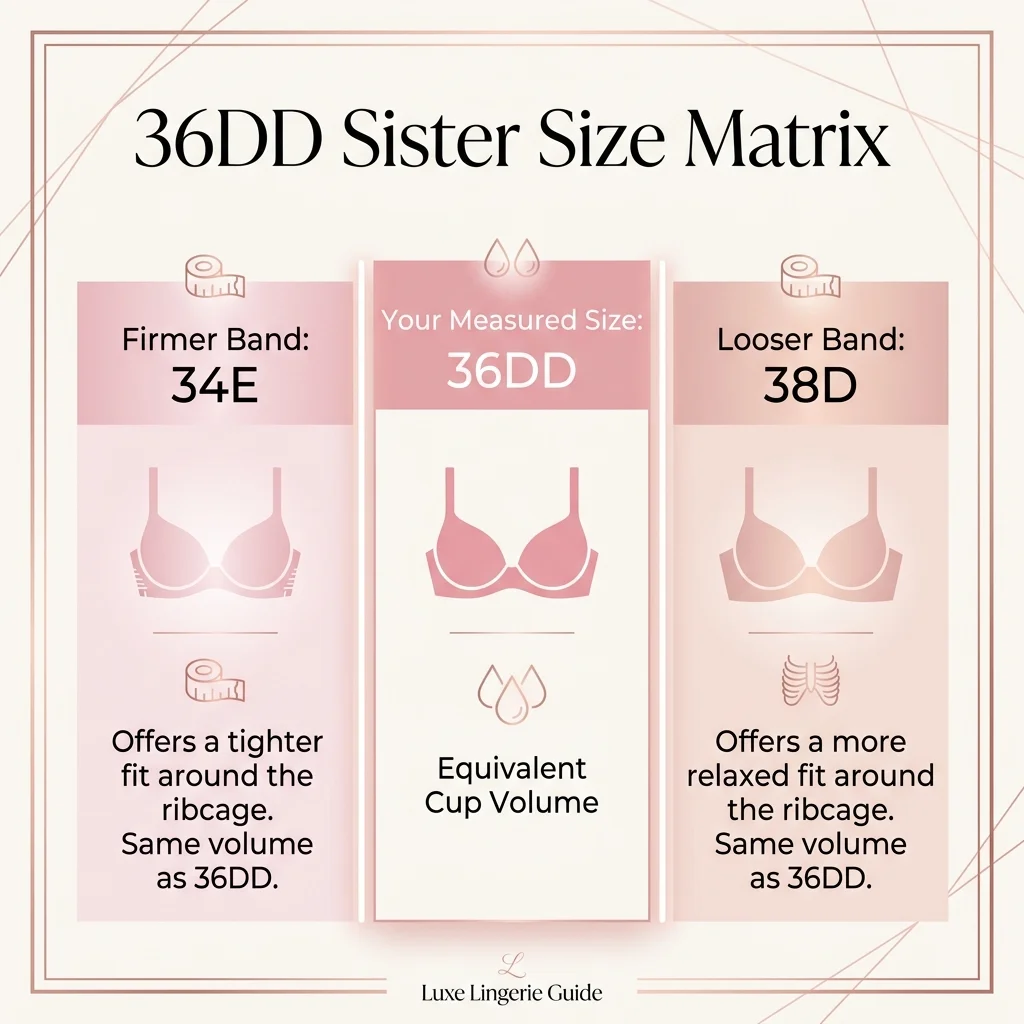
Sister sizes are the same cup volume in a different band. If the cups fit but the band doesn't, you move sideways rather than starting from scratch: down a band, up a cup; up a band, down a cup.
| Band change | UK sister size | When to try it |
|---|---|---|
| Two down | 32F | 36DD band rides up badly; small, firm ribcage |
| One down | 34E | Band feels loose even on the tightest hook |
| Your size | 36DD | Band snug on the loosest hook, cups smooth, gore tacking |
| One up | 38D | Band digs in, restricts breathing, leaves deep marks |
| Two up | 40C | 36DD is genuinely painful across the ribs |
34E is the first place to go. In practice it's the most useful alternative to a 36DD bra size in the UK, and a large share of women wearing 36DD should be in 34E — the band gets shorter and firmer, the cup gains an inch of volume, and the total volume stays the same.
Sister sizing has limits worth naming. The cup volume matches, but the cup shape changes: a 34E is narrower and deeper than a 36DD bra size, so if you're broad-rooted the 34E may cut in at the underarm even though the maths is right. Strap placement and wire width shift too. Sister sizes are a shortlist, not a substitution.
36DD vs 36E vs 36D: choosing between neighbouring cups
Same band, one inch of volume apart in each direction, and the differences show up in specific places.
Go to 36E if there's any spillage at the top edge, if the gore won't tack, or if the wire is sitting on tissue at the sides. Bust measuring 42" rather than 41" is the arithmetic version of the same signal. Go to 36D if the cup wrinkles at the apex, if you can pinch fabric at the top of the cup, or if there's a visible gap when you lean forward. Stay in the 36DD bra size if the band is snug at the loosest hook, the gore is flat, and the top edge is smooth under a t-shirt.
Cup shape complicates that. Full-on-top busts often need the larger cup to avoid cutting in; full-on-bottom busts frequently gape at the top of a correct size, which is a style problem, not a size one — a balconette or plunge fixes it where a full cup won't.
Signs your 36DD bra size is wrong, and what to try instead
- Band riding up your back. The classic. Go down to 34E — not up.
- Spillage over the top or the sides. Cup too small: try 36E.
- Gaping or wrinkling in the cup. Cup too big, or wrong shape: try 36D, or change style before you change size.
- Gore lifting off the sternum. Nearly always a cup issue, not a band one.
- Straps sliding off or digging in. The band is too loose and your shoulders are compensating.
- Wire poking under the arm. Wire too narrow for your breast root — a brand problem, not necessarily the wrong 36DD bra size.
- Fastening on the tightest hook from day one. You've got no life left in the bra. Size down the band.
- Back pain, shoulder grooves, red marks along the underband. All point to the same thing: the band isn't doing its job.
Best bra styles for a 36DD bra size
Balconette and full-cup styles with side support panels do the most work at this size — they push tissue forward instead of letting it drift towards the underarm, and they're the reason specialist brands fit better than generic ones. Moulded T-shirt bras are fine under fine-gauge knitwear but tend to run shallow, so check the top edge for cutting in. Plunge styles suit fuller-on-bottom shapes and solve gaping better than sizing down does.
For sport, choose encapsulation over flat compression. Separate cups plus a firm band is the only thing that reliably controls movement at DD and above; Shock Absorber and Panache Sport both go well past this size. Strapless is the hard category — look for silicone-lined bands, four hooks and a wide gore, and size the band down before you write it off. And check every brand's own chart, because a 36DD bra size in one label can run a full cup off another.
36DD bra size conversion: US, EU, French and Australian
| Region | Equivalent |
|---|---|
| UK | 36DD |
| US | 36DD |
| EU (Germany, Netherlands) | 80E |
| France / Spain | 95E |
| Italy | 4E |
| Australia / New Zealand | 16DD |
| Japan | E80 |
UK and US happen to align at this exact letter — both use DD for a five-inch difference — so a 36DD bra size converts straight across. They split immediately above it: UK E becomes US DDD or F, and the gap widens with every letter after that. European labelling has no double-D at all, so DD maps to E, and the band converts by ribcage centimetres rather than inches.
Where to get fitted for a 36DD bra size in the UK
Free in-store fittings are available at Marks & Spencer, John Lewis, Bravissimo and Boux Avenue, and no appointment is needed at most branches. Bravissimo is the one to choose if you're at DD or above — their entire range starts at D, their fitters work by shape rather than tape measure alone, and they'll bring you sizes you didn't ask for. That last part matters: a good fitter treats a 36DD bra size as a starting hypothesis, not an answer.
Whichever route you take, remeasure every six to twelve months, and sooner after weight change, pregnancy, breastfeeding or hormonal contraception changes. Rotate three bras rather than wearing one to death, wash them in a bag on a cool cycle, and never tumble dry. A well-made bra that fits gives you around a year of daily wear before the band goes.
Frequently Asked Questions
Above average, but common. DD is the fifth cup letter in UK sizing and the point where specialist fuller-bust ranges begin.
Need to check your measurements right now?
Use our free online UK Bra Size Calculator to calculate accurate band and cup sizes in seconds using cm or inches.
Calculate Bra Size Free