34D vs 36C: Same Cup, Different Band — Which Fits You?
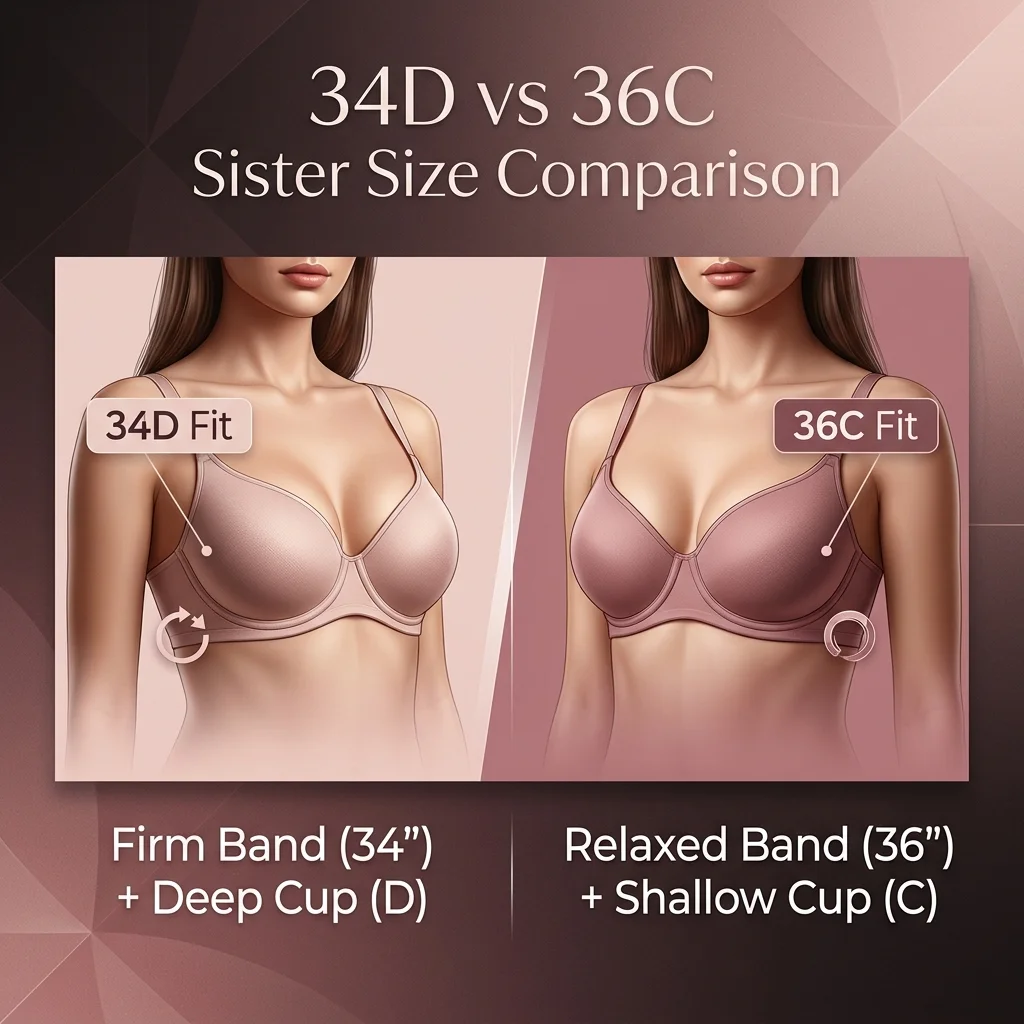
Two women can walk into the same fitting room, one holding a 34D and one holding a 36C, and both be correct. The cup volume is identical. What separates them is two inches of band and the ribcage underneath it — and that difference decides whether your bra still feels right at dinner or you've been quietly tugging at it since lunch.
The short answer
A 34D and a 36C are sister sizes: the same cup capacity, on band lengths that differ by two inches. The 34D grips a smaller ribcage and delivers more support; the 36C sits on a wider frame with a looser feel. Your underbust measurement decides which — not the label.
That's the version you can act on in thirty seconds. The rest of this matters because "equivalent in cup volume" and "fits the same" are two different claims, and the second one isn't true. The circumference around your rib cage, the projection of your tissue, and the shape of the cup itself all pull the two sizes apart in ways the fit on a hanger never shows. Everything below uses US sizing, and it's snug measurements throughout.
What a sister size actually is — and what it isn't
Here's the mechanic. Move the band number up by two, drop the cup letter by one, and the volume stays roughly where it was. That gives you a chain: 32DD → 34D → 36C → 38B. Four labels, one cup capacity, four completely different bands. Bra people call this the ladder, and once you see it, a lot of fitting-room confusion resolves itself.
What trips people up is the misconception buried in the sizing system — that a letter means a fixed amount. It doesn't. A C cup isn't a quantity; it's a relative measure, the gap between your bust and your band. A 30C and a 40C share a letter and almost nothing else. This is the letter drift that makes the alphabet feel arbitrary: the same character describes wildly different cups depending on the number in front of it.
So a sister size is a cross-grade, not an upgrade. Going from a 36C to a 34D doesn't give you more room. It gives you the same room, held on tighter. If your actual complaint is that you're spilling out, sister sizing won't fix it — you need a genuinely bigger cup, which is a different move entirely.
Measure your underbust first, and drop the +4 method
Get a soft tape measure, stand in front of a mirror, and measure bare-chested directly under your bust. Pull it snug — firm enough that it won't slide, not so tight it hurts. Keep it level all the way around your rib cage; the back tends to droop and that's where the error creeps in. Exhale normally and read the number.
Now here's where most sizing guides, including a lot of the ones ranking above this one, will steer you wrong. They'll tell you to add four inches to that number. That's the +4 method, and it's a legacy rule from the 1950s, back when bands had almost no elastic and needed slack built in to be wearable. Modern bands stretch. Adding four inches to a stretchy band gives you a band that does nothing.
The current approach is simpler: take your underbust and round to the nearest even number. Measure 33″, you're a 34 band. Measure 35″, you're a 36. Some fitters add an inch on very soft or fleshy torsos, and that's a reasonable judgment call — but four is not.
Then the cup. Measure your bust measurement at the fullest point, standing upright, tape level and not compressing anything. Subtract your band number. That differential is your cup letter: 1″ is an A, 2″ a B, 3″ a C, 4″ a D, 5″ a DD. So a 34″ band with a 38″ bust gives you 4″ — a 34D. A 36″ band with a 39″ bust gives you 3″ — a 36C. Same cup capacity, different frames.
If you've been sizing yourself with +4 for years, run this calibration again before you decide anything. A meaningful share of people who land on the 34D-versus-36C question discover they were never either one.
34D vs 36C, side by side
| Feature | 34D | 36C |
|---|---|---|
| Band length | 2″ shorter, firmer tension | 2″ longer, more relaxed |
| Snug underbust range | 33–34″ | 35–36″ |
| Bust range | ~38″ | ~39″ |
| Cup depth | Deeper, more forward projection | Shallower |
| Wire width | Narrower wire span | Wider |
| Support level | Higher — band is the anchor | Lower — straps pick up slack |
| Lift over a full day | Better stability | Can settle by evening |
| Hook you should start on | Loosest hook | Loosest hook |
| Wrong if | Can't breathe; deep marks after 20 min | Band rides up; straps dig |
The spec that decides it is the underbust row. Everything else follows from it. If your comparison comes down to "they both kind of worked," you're comparing them on the wrong thing — see the next section.
The fit differences you'll feel by 6 p.m.
Morning is a liar. A too-loose band feels wonderful for the first hour, which is exactly why so many people are wearing one. The signals show up later, and they're specific enough that you can diagnose yourself without a fitter.
Ride-up is the clearest one. Stand sideways at the mirror in the afternoon. If your back band has climbed above the underwire at the front, it's too loose — that migration is the band losing its grip and being dragged upward by the straps. In a 34D-versus-36C decision, band ride-up is a straight vote for the 34D.
Strap digging is the same problem wearing a different disguise. Straps are meant to carry maybe a fifth of the load. When the band quits, they take the rest, and you get shoulder grooves and a neck that aches by evening. If you've tightened your straps as far as they go and still feel unsupported, that's not a strap issue — that's a band that's two inches too long.
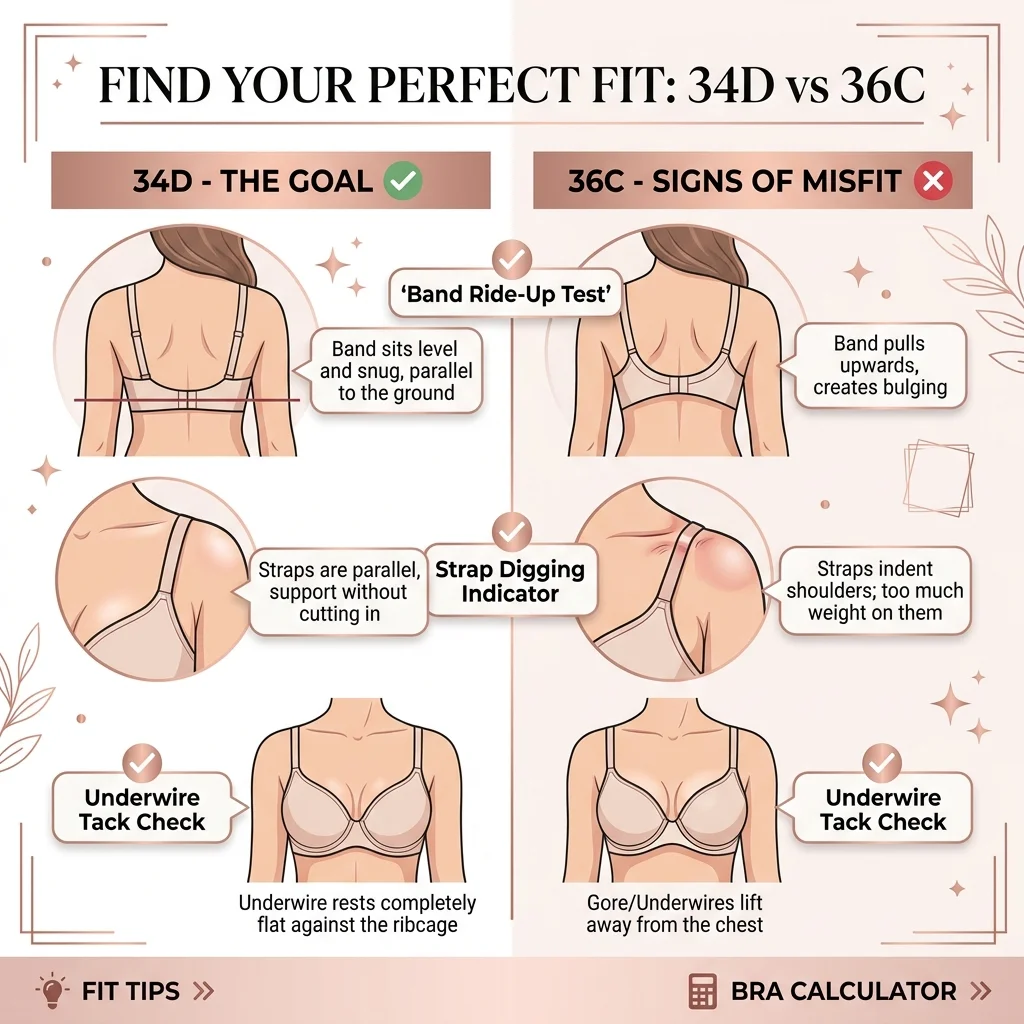
Check the gore, the little bridge between the cups. It should tack flat against your sternum. If it floats off your chest, the band isn't pulling the cups inward hard enough. Then do the two-finger test: slide two fingers under the band at your spine. Snug resistance is right. If they slip in with room to spare, size down.
Going the other way, the 34D is too small if you're getting red marks that are still there twenty minutes after you take it off, if breathing deeply feels restricted, or if you can't fasten the loosest hook on day one. Some compression is normal and expected. Pain isn't. And if the whole bra is slippage-prone and spinning around your torso during all-day wear, that's a loose band too — a correctly fitted one barely moves.
Why equal volume can still fit completely differently
Two cups can hold the same amount and still be shaped nothing alike. The 36C is built on a wider frame, so its cup width and wire span are broader and its shallow profile spreads that volume out. The 34D takes the identical volume and concentrates it — narrower, deeper, more projection forward from the chest wall.
Which one suits you depends on your breast root, the footprint where your tissue attaches. A narrow, close-set root in a 36C means the wire lands on breast tissue instead of ribcage, and you'll often see gaping at the outer edge even though the total volume is right. A broad, wide-set root in a 34D gets the opposite: the narrow wire sits on top of tissue at the sides and you get spillage under the arm.
Shape distribution matters just as much as root width. Full-on-top breasts tend to overflow the upper edge of a shallow cup, which pushes you toward the deeper 34D. Full-on-bottom shapes usually do better in the roomier lower quadrant of a wider cup. This is the geometry that explains the thing everyone finds maddening: two people with matching tape numbers trying both sizes and reaching opposite conclusions. Neither one is measuring wrong.
Which one to pick, based on your ribcage and shape
Go 34D if your snug underbust is 33–34″, your current band rides up, you're tightening straps for support, your gore floats, or your breasts are projected and narrow-rooted. Choose it too if you want a firm band for high-impact work — a sports bra on a loose band is barely a sports bra, and band secureness is most of what stops bounce.
Go 36C if your snug underbust is 35–36″, the 34D leaves marks that outlast the bra, you have a wide root or fullness toward the sides, or you feel the 34D wire pressing into soft tissue rather than sitting on bone. Genuine rib sensitivity is a real constraint and not something to push through — a slightly relaxed band you'll actually wear beats a perfect one you won't.
Two things people forget. Torso length changes what a band feels like: a short torso puts the band close to the waist and makes a firm 34 feel tighter than the tape suggests. And posture matters — rounded shoulders and shoulder pain often trace back to a loose band long before they trace back to anything else.
If you're right on the line, take the 34D as your starting size, wear it around the house for half an hour, and let the band's behavior decide. Your own comfort tolerance for daily wear is a legitimate input to this decision, not a failure of measuring.
Why a 34D isn't a 34D in every brand
Nobody in the top search results will tell you this plainly, so: the label is a starting point, not a promise. Brand variance in bands and cup shape is large enough to flip your answer entirely.
Wacoal tends to run close to its size chart with structured, firm bands. ThirdLove builds around a wide fit range and offers half-cup sizes, which is genuinely useful if you keep landing between two. Mall-brand basics from Victoria's Secret or Aerie lean on stretchy, forgiving bands and molded cup construction — and that stretch is the problem, because a too-large band feels fine in a stretchy style right up until it stops supporting you. If you're testing 34D against 36C seriously, do it in an unlined or lightly lined style with a firmer band. It tells the truth faster.
The other thing to know as a US shopper: some of the best-fitting brands here use UK sizing. Panache, Freya, Elomi, and Curvy Kate are British houses with firm bands and excellent shape support, and their lettering diverges from the US system above DD. A US DDD is a UK F cup. At 34D and 36C specifically you're fine — the letters match at this point in both systems — but the moment you size up a cup, check which system the tag is using.
And a word on vanity sizing: bands labeled generously are common, which is another reason to trust your afternoon experience over the number printed on the tag.
When neither size is right — and this happens a lot
This is the part the other guides skip, and it's probably the most useful paragraph on this page. If you've tried both a 34D and a 36C and neither felt right, the most likely explanation isn't that you split the difference. It's that you're a different size in a different family — commonly 32DD or 34DD.
Here's why. If you measured yourself with the old inflated +4 rule, your band came out two to four inches too big, and the cup letter that got calculated from it came out too small to compensate. The women most likely to be searching "34D vs 36C" are frequently 32DDs who were told they were 36Cs. Same volume ladder, wrong rung.
The tell is overflow with a loose band at the same time: quadrant spillage at the top or under the arm while the back band slides around. That combination means wrong band, not wrong cup. Before you settle on either size, do the scoop and swoop — lean forward, reach into each cup from the outside, and pull all the tissue from your side and underarm forward into the cup. Most people are leaving a real amount of volume behind, which makes cups look empty at the top and reads as "too big" when it isn't.
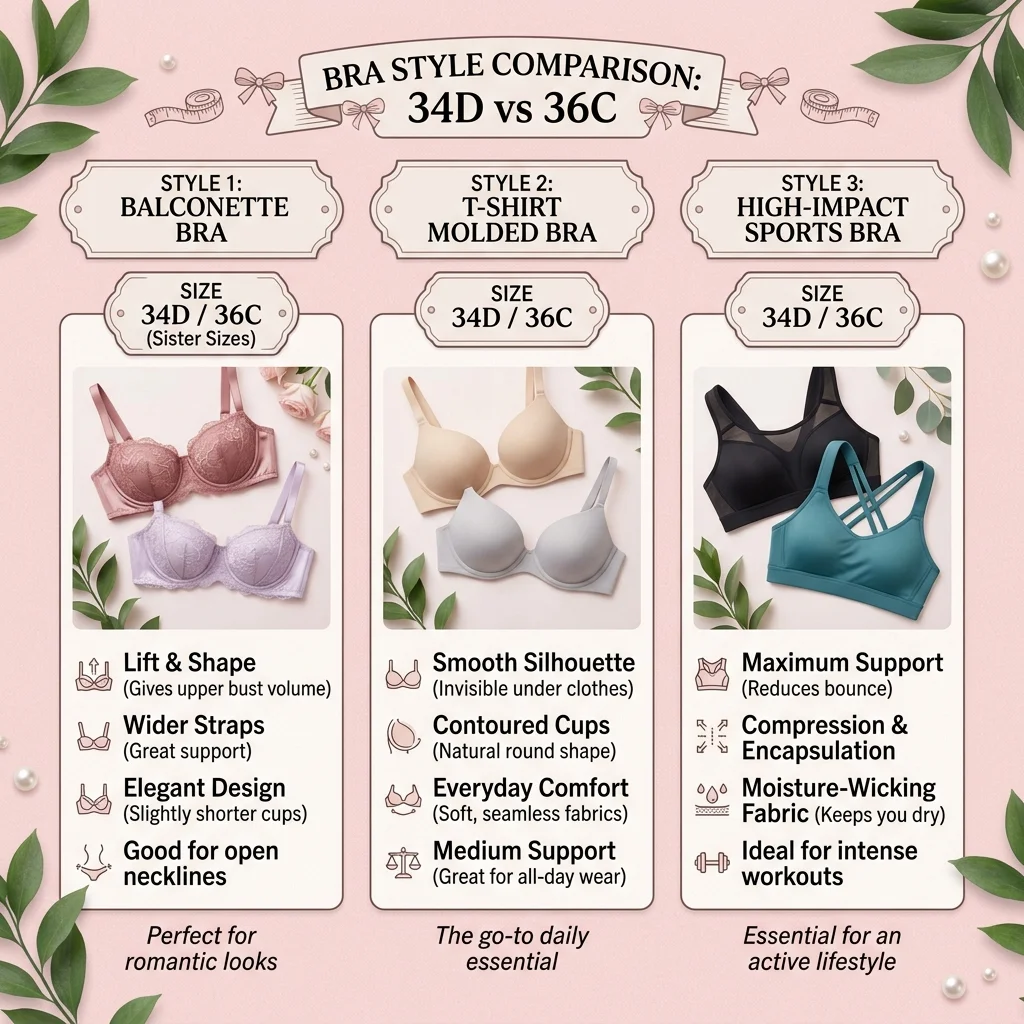
Then re-measure with the snug method above, run a fit calculator if you want a second opinion, and try the neighbors: 32DD for a firmer band at the same volume, 36B if you need a wider band and less depth, 34DD if you scooped and found you're overflowing. Style helps too — balconette and side support shapes handle wide roots, plunge works for close-set, and a full-cup is the safest bet if you're fuller on top.
When sister sizing is a smart move, and when it's a shortcut
Sister sizing earns its keep as a substitute. Your size is out of stock, the one you want is on clearance in the neighboring size, you're doing a brand switch and their band runs tight — reaching for a band-up or band-down sister is exactly the right call. It's also a sensible stopgap through weight fluctuation, bloating, the back half of your cycle, or the postpartum stretch when your ribcage is still deciding what it wants to be.
Where it goes wrong is as a permanent answer. If your real underbust is 33″ and you're wearing a 36C because it's what the store had, you've accepted a trade-off every day: less lift, more strap load, a band that migrates. That's fine for a wedding. It's not fine for your daily driver. Buy the temporary size knowing it's temporary, then get the right one.
Bands stretch: why your size changes in six months
A new band should fasten on the loosest hook. That's not a comfort preference — it's built-in headroom. Elastic degradation is inevitable, and the extra hooks exist so you can chase it as the band gives.
Expect roughly six months of solid life from a bra in regular rotation, less if it's your only one. Each wash cycle costs you a little recovery in the elastic, and heat costs you a lot. Hand wash where you can, use a laundry bag and cold water when you can't, and always air dry — a dryer will halve the lifespan of a good band. Owning three and rotating them will outlast owning one and wearing it daily, by more than you'd guess.
Watch the hook migration. When you've reached the tightest hook and the band still isn't holding, that's the end of its useful life, not a signal that you've changed size. And this is the honest answer to a question a lot of people have: if you bought a 36C a year ago and it feels loose and saggy now, the fix may not be a 34D. It may just be a new 36C. Check the wear pattern and the sag in the band before you re-diagnose your whole size.
Frequently Asked Questions
In cup volume, no — they hold the same amount. The 36C has the bigger band; the 34D has the deeper, narrower cup. 'Bigger' depends on which dimension you mean.
Need to check your measurements right now?
Use our free online UK Bra Size Calculator to calculate accurate band and cup sizes in seconds using cm or inches.
Calculate Bra Size Free