The Ultimate 34B Bra Size Guide: Measurements, Fit, and Style

A 34B bra size means a 34-inch band around your ribcage and a roughly 2-inch difference between your band and the fullest part of your bust — which is what makes the cup a B. In plain numbers, that's an underbust of about 29–30 inches (73–77 cm) and a bust near 36 inches (87–91 cm). It's one of the most common sizes out there, sits squarely in the average/medium range, and — this is the part most guides skip — it fits very differently from body to body. Let's get you from a label to a bra that actually works.
What a 34B bra size actually means
The size splits into two jobs. The band size (34) carries about 80% of the support — it's the number wrapped around your ribcage, just under the breasts. The cup size (B) describes volume, not a fixed amount of tissue. That distinction trips people up constantly. A B cup isn't some absolute quantity; it's the gap between your band measurement and your bust measurement, and that gap scales with the band.
Here's the thing I keep having to explain in fittings: a 34B does not hold the same volume as a 32B or a 36B. As the band gets bigger, the same cup letter holds more. So the "B" is only meaningful once you nail the band. Get the number wrong and the letter is basically noise.
The gore — that little strip of fabric between the two cups — is your quiet fit tell. On a correct 34B it lies flat against your breastbone. If it floats off your chest, the cup or band is fighting you.
34B measurements in inches and centimeters
Two numbers define this size. Your snug underbust should land around 29–30 inches (73–77 cm) — that becomes the 34 band. Your overbust, measured across the fullest point, sits near 36 inches (87–91 cm). Subtract one from the other and you're looking at that ~2-inch difference that maps to a B cup.
In centimeters, most charts put a 34B at roughly an 86 cm band and a 91 cm bust. Don't obsess over hitting a number to the millimeter, though. Tape tension, posture, and even the time of day nudge these figures. The measurement gets you to the fitting room; it doesn't crown you a 34B for life.
How to measure yourself at home (and skip the outdated +4 rule)
Grab a soft measuring tape, stand in front of a mirror, and wear your best-fitting bra (or none). Wrap the tape snug and level around your ribcage right under the bust for the band, keep it parallel to the floor, and note it. Then measure loosely around the fullest part for the bust. Subtract band from bust — about 2 inches means B.
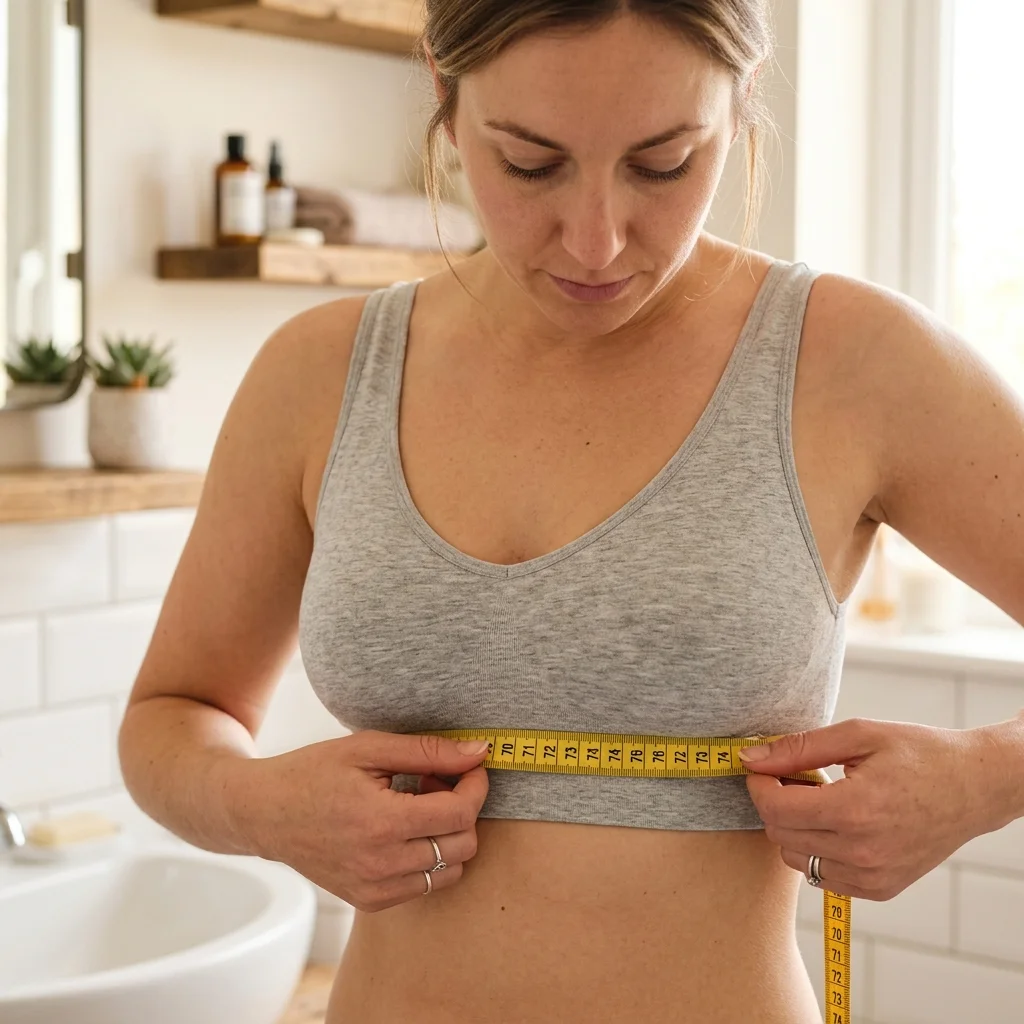
Now the part I'll die on: ditch the old "+4 inches" rule. For decades the traditional method told you to add 4 to an even underbust (or 5 to an odd one) to get your band size. That advice comes from stiff, non-stretch vintage bras. Modern bands are elastic and built to grip, so adding four inches usually hands you a band that's too big — it rides up, the straps do all the work, and you blame the wrong thing. If your ribcage measures 34, buy a 34. Use the raw snug number.
One honest caveat: if your breasts are soft, projected, or uneven, a single standing bust measurement can lie. That's why a professional fitting is worth it at least once. A huge share of people wear the wrong size purely because they trusted an outdated bra size calculator and never fit-checked.
Is 34B big or small? How it looks on real bodies
Let's settle it: 34B is not small. It's a solidly medium, balanced, natural-looking size — plenty of people, including a few well-known names by their reported stats, wear it and never think twice. The idea that a B cup is "tiny" comes from ignoring the band, and we just covered why that logic falls apart.
What it looks like depends far more on your frame and breast shape than on the number. On a petite or slim body, 34B can read full and prominent. On a taller or broad/athletic frame, the same tissue can look shallow and understated. Same size, completely different silhouette.
Shape matters just as much. A teardrop 34B fills the bottom of the cup beautifully but may gap at the top. A rounder, more even shape tends to fill the whole cup. Neither is a problem to fix — it's a shape to fit around. And the style you reach for shifts the look: a push-up rounds and centers, while a soft wireless cup gives a relaxed, natural line.
34B sister sizes — and when to reach for one
Sister sizes are the sizes that hold the same cup volume but shift the band up or down. For a 34B, they're 32C (down a band, up a cup) and 36A (up a band, down a cup). Same amount of breast, different band. They're a genuine lifesaver when a bra is almost perfect but the band feels a touch off.
Here's the nuance nobody spells out, though. A sister size only fixes a band problem, not a cup shape problem. If your 34B band feels loose and rides up, dropping to a 32C tightens the band while keeping the cup — smart move. But if you're spilling over the top, that's a cup-volume issue, and the sister size won't save you; you want a 34C. If the cup gaps empty at the top, you may want a 34A or simply a different cup shape. Reach for a sister size to solve fit around the ribs, and re-measure or change the cup when the volume is wrong.
34B around the world: US, UK, and EU conversions
Bra size conversion is messier than it should be because every region counts differently. In US sizing, 34B is 34B. UK sizing usually lines up closely — a US 34B is commonly a UK 34B too, at least at this end of the range. So far, easy.
Europe is where the number jumps. Since EU bands are measured in centimeters, a 34B lands at roughly a 75B (that 75 is the band in cm), and French sizing often labels it around a 90. Australia and Japan run their own scales again. Treat any chart as a starting reference, not a promise — pull up the specific brand's own size chart before you buy across regions.
How 34B compares to 34A, 34C, and 34D
Since the band stays at 34 across all four, the only thing changing is cup depth. A 34A has about an inch less breast volume than a 34B — same band, shallower cup. If a 34B gaps at the top with air to spare, 34A (or a shallower cup shape) is often the answer. Just don't automatically assume A; if it gaps because the band is loose, a 32C may beat a 34A.
Go the other way and a 34C gives roughly an inch more room and a fuller curve. If your 34B flattens you, digs at the top edge, or you're getting that "double boob" spill, 34C is the natural next step. A 34D is deeper still, for more projection and coverage. The pattern's simple: same band, and each letter up adds volume. Your job is matching the cup to how much tissue you actually have — and how far forward it sits.
Signs your 34B doesn't actually fit
A correct 34B should feel snug but never painful, and the band should sit level all the way around. The clearest red flag is the back band riding up — that means it's too loose, and either the band comes down a size (hello, 32C) or you've been oversized by the old +4 habit. If the band digs in sharply, leaves deep marks fast, or you can't breathe, it's too tight or the wrong shape.
Up top, watch for two opposite problems. Spillage — tissue bulging over the cup edge or at the sides — means not enough cup; compare a 34C. Gapping — empty space, cup wrinkling or collapsing — means too much cup or the wrong shape; look at a 34A, a shallower molded style, or a stretchier fabric. Straps that constantly slip or dig into your shoulders are usually a band that's not doing its job, not a strap problem. And that flat gore rule holds: if the center won't tack down against your chest, the fit is off no matter what the label says.
One more real-world thing I run into: brand variation. A 34B in one label can genuinely feel like a 32C or 34C in another because of cup grading, wire width, and how much the fabric stretches. Wearing "34B" in one brand and a different size in the next isn't your body changing — it's the brands not agreeing. Fit the bra, not the tag.
The best bra styles for a 34B
At this size you have real range, which is the fun part. For everyday wear under fitted clothes, a lightly lined T-shirt bra is the workhorse — seamless, smooth, invisible under a plain top. A demi or balconette gives a lower-cut, lifted shape that's great under wider necklines. Prefer nothing structured? A bralette or wireless bra is comfortable and low-key, and B cups carry wire-free support better than fuller sizes do.
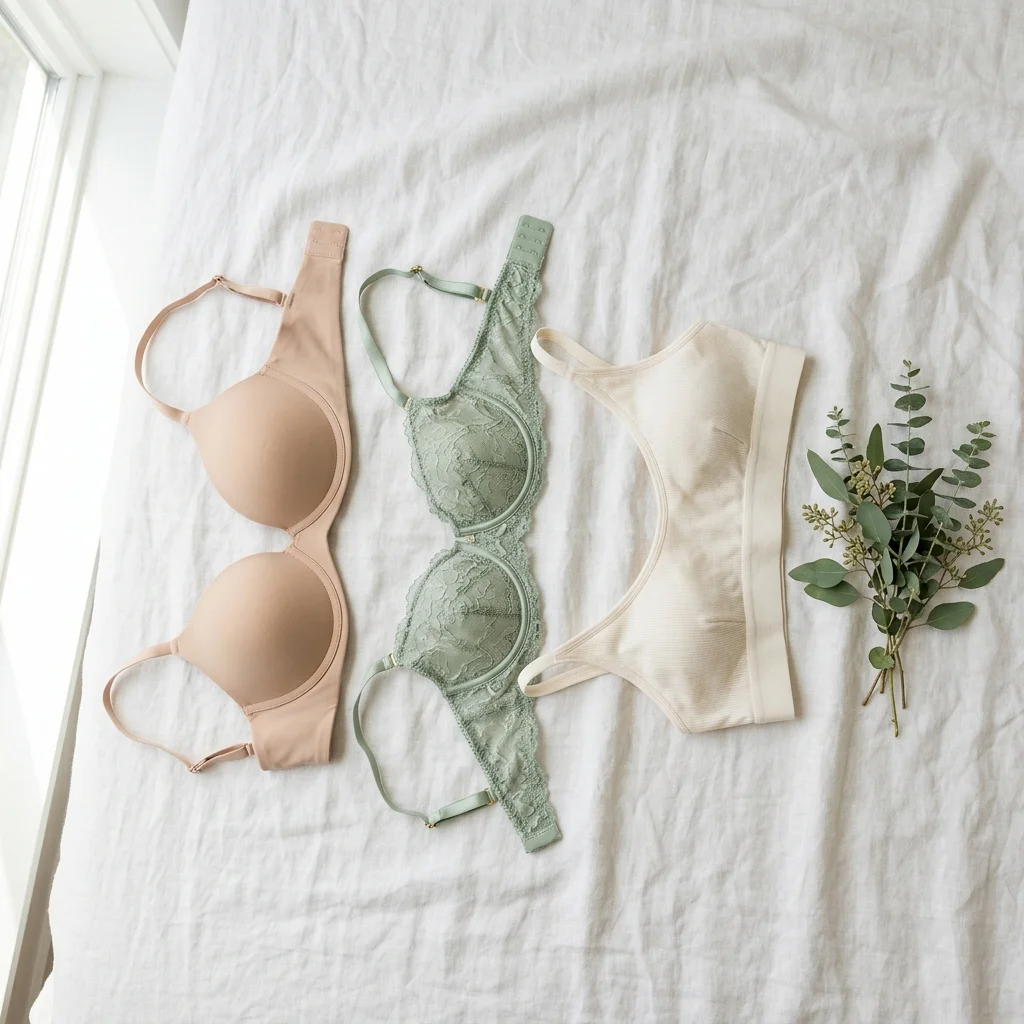
Match the style to your shape, not just the occasion. If your tissue sits wide on the chest, plunge bras and side-support styles guide it inward and centered. If it projects forward, seamed cups, stretch lace, or a deeper plunge stop molded cups from wrinkling or pressing flat at the base. Want more cleavage for a night out? A push-up with light padding adds lift and roundness. The rule I give everyone: buy the shape that fits how your breasts actually sit, and let the number be a starting point — a well-fitting 34B should feel light, stay put, and let you forget you're wearing it.
Frequently Asked Questions
No. It's an average, medium size — bigger than 34A, smaller than 34C, and one of the most commonly stocked sizes in stores.
Need to check your measurements right now?
Use our free online UK Bra Size Calculator to calculate accurate band and cup sizes in seconds using cm or inches.
Calculate Bra Size Free